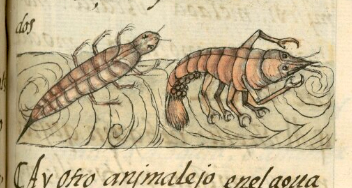
acocilin (FCbk11f68r)
This iconographic example, featuring a crayfish (acocilin), is included in this digital collection for the purpose of making comparisons with related hieroglyphs. The term selected for this example comes from the text near the image in the Digital Florentine Codex. There is no gloss, per se. This example shows a semi-bird’s eye view of a crayfish, facing toward the viewer’s right. It is pink in color, and the carapace is segmented so that the body and tail can bend. Tucked inside the tail appears to be a cluster of eggs. The tail has a fan (uropod) at the end, too. Six legs are visible, all with pincers, and the two farthest forward are held upward, with the pincers near the head. The head comes to a point at the rostrum. It has two eyes on top and antennae on both sides of the point. This animal is placed in a watery landscape, where there are lines of current and a visible whirlpool. A landscape placement suggests European artistic influence, but the prevalence of whirlpools seems Mesoamerican.
Stephanie Wood
One example of a crayfish appears in this digital collection (as of October 2025), but it is a personal name, Cozol, short for cozolin, another term for crayfish.
Stephanie Wood
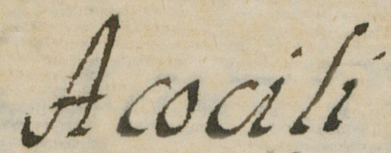
Acocili
acocilin
Stephanie Wood
1577
Jeff Haskett-Wood
langostinos, mariscos, tenazas, remolino, remolinos
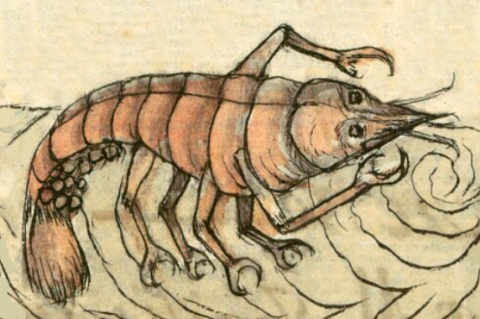
acocil(in), a small crayfish, https://nahuatl.wired-humanities.org/content/acocilin
cozol(in), crayfish, https://nahuatl.wired-humanities.org/content/cozolin-1
el langostino
Stephanie Wood
Available at Digital Florentine Codex/Códice Florentino Digital, edited by Kim N. Richter and Alicia Maria Houtrouw, "Book 11: Earthly Things", fol. XXX, Getty Research Institute, 2023. https://florentinecodex.getty.edu/en/book/11/folio/XXX/images/0 Accessed 16 October 2025.
Images of the digitized Florentine Codex are made available under the following Creative Commons license: CC BY-NC-ND (Attribution-NonCommercial-NoDerivs 4.0 International). For print-publication quality photos, please contact the Biblioteca Medicea Laurenziana ([email protected]). The Library of Congress has also published this manuscript, using the images of the World Digital Library copy. “The Library of Congress is unaware of any copyright or other restrictions in the World Digital Library Collection. Absent any such restrictions, these materials are free to use and reuse.”