amolli (FCbk11f133r)
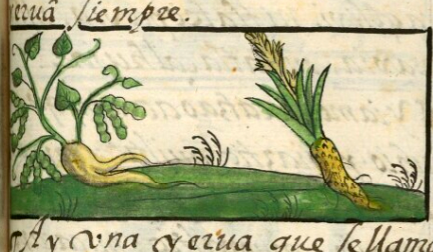
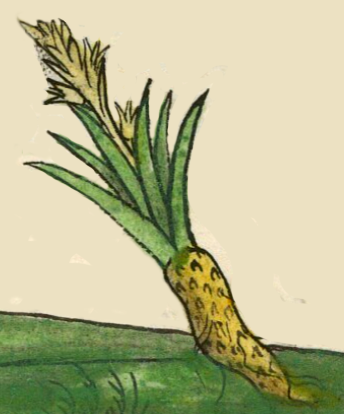
This iconographic example, featuring a soap root (amolli, spelled hamolli in this manuscript), is included in the digital collection for the purpose of making comparisons with related hieroglyphs. The term selected for this example comes from the text near the image in the Digital Florentine Codex. There is no gloss, per se. This example shows a root plant that has been pulled up and is lying at an angle on some grass. The plant that was above the ground has six long, pointy, green, slender leaves. Coming up through the middle of the leaves is a yellow flowering stalk. The large root is yellow and has many small hair-like roots coming off of it. Shading provides three dimensionality to this scene, and together with the landscape setting, it suggests European artistic influence.
Stephanie Wood
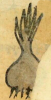
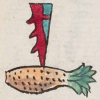
Two examples of amolli tubers appear already in this digital collection, both of them hieroglyphs. One is from the place name Huitzamollan, and the other is a personal name, Amol (apocopated). The greenery on these tubers is not significantly different from this iconographic example. This is true, too, of the texturing and yellow-tan coloring on the place name’s root. One other interesting example of amolli is what the tlacuilo calls “amolli Caxtillan,” meaning Castile soap.
Stephanie Wood

hamolli
amolli
Stephanie Wood
1577
Jeff Haskett-Wood
tubérculo, raíz, raíces, jabón, lavar el pelo, limpieza
amol(li), soap from a plant root, https://nahuatl.wired-humanities.org/content/amolli
el amole
Stephanie Wood
Available at Digital Florentine Codex/Códice Florentino Digital, edited by Kim N. Richter and Alicia Maria Houtrouw, "Book 11: Earthly Things", fol. 133r, Getty Research Institute, 2023. https://florentinecodex.getty.edu/en/book/11/folio/133r/images/0 Accessed 16 November 2025.
Images of the digitized Florentine Codex are made available under the following Creative Commons license: CC BY-NC-ND (Attribution-NonCommercial-NoDerivs 4.0 International). For print-publication quality photos, please contact the Biblioteca Medicea Laurenziana ([email protected]). The Library of Congress has also published this manuscript, using the images of the World Digital Library copy. “The Library of Congress is unaware of any copyright or other restrictions in the World Digital Library Collection. Absent any such restrictions, these materials are free to use and reuse.”