ayotl (FCbk11f63v)
This iconographic example, featuring a freshwater turtle (ayotl), is included in this digital collection for the purpose of making comparisons with related hieroglyphs. The term selected for this example comes from the text near the image in the Digital Florentine Codex. There is no gloss, per se. This example shows a bird’s eye view of the turtle, but its head is shown in a profile view. Its shell is a light gray with faint, wavy stripes. The middle and top of the shell shows a row of uppercase Cs, which give it a three-dimensionality. Its head, legs, and tail are dark gray or black. Its feet have long sharp nails, and the feet are webbed for swimming. Its mouth is beaked. On the back of this folio (64v) one can find an image of two Nahua men capturing turtles at the water’s edge.
Stephanie Wood
The most detailed and colorful turtle in this collection is the ayotl from the Codex Mendoza (below). Interestingly, that one is displayed with its underside up. Another ayotl, or maybe ayotli (squash), also comes from the Codex Mendoza. In contrast, the Matrícula de Huexotzinco offers suggestions of turtles (their feet, tails, and heads) hiding under what seem to be war shields (called yaotl, which really means enemy or combatant). These artists seem to be taking advantage of the ayotl to disguise the prevalence of names that relate to warfare. If not a conscious scheme, then the artists were introducing phonetics to the readings of the names, given that ayotl and yaotl are near homophones.
Stephanie Wood
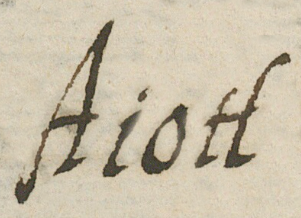
Aiotl
ayotl
Stephanie Wood
1577
Jeff Haskett-Wood
tortugas, carapazón, carapazones, pico ganchudo, motetiani, egg-layer
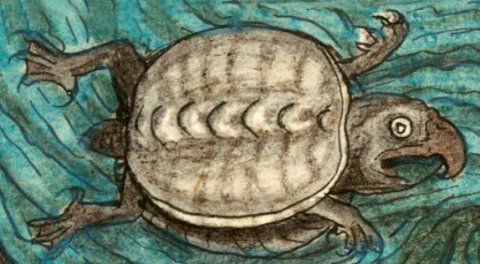
ayo(tl), a freshwater turtle, https://nahuatl.wired-humanities.org/content/ayotl
la tortuga (de agua dulce)
Stephanie Wood
Available at Digital Florentine Codex/Códice Florentino Digital, edited by Kim N. Richter and Alicia Maria Houtrouw, "Book 11: Earthly Things", fol. 63v, Getty Research Institute, 2023. https://florentinecodex.getty.edu/en/book/11/folio/63v/images/0 Accessed 16 October 2025.
Images of the digitized Florentine Codex are made available under the following Creative Commons license: CC BY-NC-ND (Attribution-NonCommercial-NoDerivs 4.0 International). For print-publication quality photos, please contact the Biblioteca Medicea Laurenziana ([email protected]). The Library of Congress has also published this manuscript, using the images of the World Digital Library copy. “The Library of Congress is unaware of any copyright or other restrictions in the World Digital Library Collection. Absent any such restrictions, these materials are free to use and reuse.”