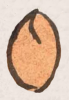
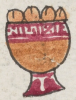
cacahuatl (TK217r)
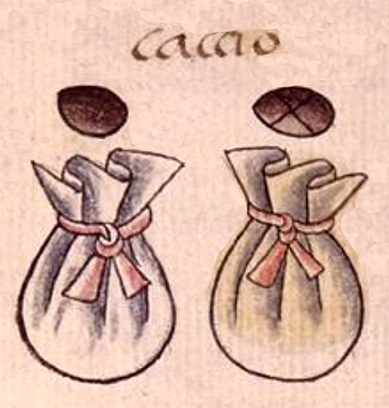
This painted simplex Nahuatl hieroglyph represents a cacao bean (cacahuatl). While there is no Nahuatl gloss, the Spanish-language gloss (cacao) is sufficient to know the Nahuatl term that is implied. It also aligns with various hieroglyphs for cacahuatl. This example shows one simple cacao bean hovering over each of the 18 large white cotton sacks tied with a red leather strip or cotton cord that appear on this manuscript page. Two of these bags (called cargas in Spanish) can be seen in the contextualizing image.
Stephanie Wood
People who know Spanish will imagine that cacahuatl means peanut, but the term cacahuate is a false cognate. In sixteenth-century manuscripts cacahuatl usually refers to the cacao bean, although it can refer to nuts. The peanut, however, was usually tlalcacahuatl, the nut that grows in the soil. The cacao bean was the source of the hot chocolate that the privileged Nahua elite drank. It also became a global delight, not just as a hot drink but in many additional forms. In this case, the colonial overlord (the encomendero, holder of a grant of the right to extract tribute in kind and labor from the Nahua community) demanded the large number of eighteen loads of the prized cacao beans. This manuscript was produced as part of the community’s resistance to the unreasonable taxation being demanded vis-a-vis the size of their numbers, especially as the population was declining as a result of diseases inadvertently brought over from Europe.
Side Note: The folio numbers are not always clear in the copy published online by the British Museum. Marc Thouvenot gives this page the number K15_A in his TLACHIA digital collection, https://tlachia.iib.unam.mx/tepetlaoztoc/K15_A.
Stephanie Wood
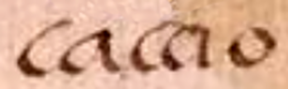
cacao
Stephanie Wood
c. 1556
Jeff Haskett-Wood
granos, tributo, tributos, cocoa, chocolate, colonialismo, resistencia
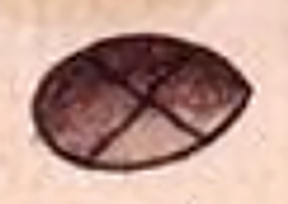
cacahua(tl), cacao bean (in this case), https://nahuatl.wired-humanities.org/content/cacahuatl
el grano de cacao
Stephanie Wood
The Codex Kingsborough, also known as the Códice de Tepetlaoztoc, and the Memorial de los indios de Tepetlaoztoc, is not on display. It was transferred from the British Library and is now held by the British Museum. It is shared on line at: https://www.britishmuseum.org/collection/object/E_Am2006-Drg-13964
©The Trustees of the British Museum. Shared under a Creative Commons Attribution-Non-Commercial-ShareAlike 4.0 International (CC BY-NC-SA 4.0) license. Please also cite the <em>Visual Lexicon of Aztec Hieroglyphsem>, ed. Stephanie Wood (Eugene, Ore.: Wired Humanities Projects, 2020-present) and this URL.