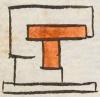
Calli (ATno6-2)
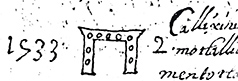
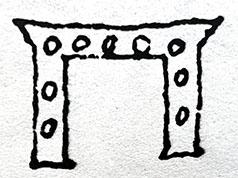
This black-line drawing of the simplex Nahuatl hieroglyph of a year sign for Calli (House) shows a frontal view of a building with two walls and a roof. The building's roof line comes to points on the right and left. The roof and walls are white one row of nine small black circles going up one side, across the top, and down the other side. The contextualizing image shows that this is the year 2 Calli or 1533 in the European calendar. This alphabetic Nahuatl manuscript begins with events of 1519, so this is fourteen years into the accounting of what happened each year--what would be called the xiuhpohualli in Nahuatl, or annals in English. The Nahua tlacuilo is well adapted to the Roman alphabet, but he still includes hieroglyphs for the year signs. This practice continued for many years.
Stephanie Wood
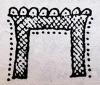
Compare this Calli year sign with the other one from the same manuscript, below. That one has a scalloped edge on the roof, mesh all over the building facade, and some stippling that this one does not have. Why the two signs vary so much remains unclear. These two Calli signs also differ a great deal from houses as they were drawn in the sixteenth century.
Stephanie Wood
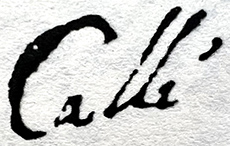
Calli
c. 1720, at the latest
Stephanie Wood
arquitectura, edificio, edificios, casas, calendario, calendarios, año, años, year, years, date, dated, fecha, fechas, xiuhpohualli, anales, Frances Krug
cal(li), house or building, https://nahuatl.wired-humanities.org/content/calli
la Casa
Stephanie Wood
Anales de Tlaxcala, 1519–1720. From a photocopy provided to Frances Krug by the Archivo Histórico del Instituto Nacional de Antropología e Historia. Currently in the Krug collection.
Creative Commons. Permission to publish here was given by BNAH Director Baltazar Brito.