caxtil (TK222v)
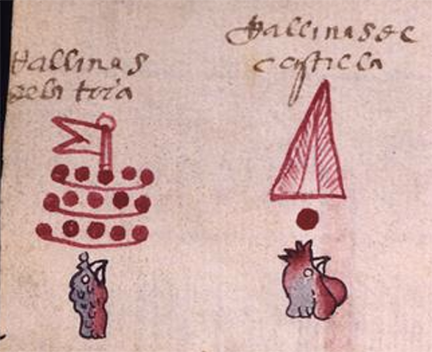
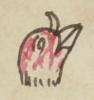
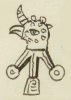
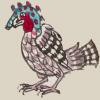
This painted simplex Nahuatl hieroglyph represents a chicken hen (caxtil). Turkeys were native to the Western Hemisphere, but chickens were brought over from Castile, hence the use of the Nahuatlized loanword that is well attested for chickens in early documents. There is no gloss that gives “caxtil” on this manuscript, but, given the Spanish-language gloss, we are surmising it would be what the tlacuilo was thinking. We have included a turkey in the contextualizing image for the value of making a comparison between the turkey and chicken hens that appear on the same page. The chicken has a large red wattle and a large red comb, whereas the turkey hen has a snood and a dewlap. Both were a part of the diet of New Spain.
Stephanie Wood
Note how turkey tribute was 15x20 (300) and chicken tribute was 1x400 (400). Chickens are rare in this early manuscript, because it was mainly Spaniards who ate them after they were just introduced. See below for some turkeys (totolin and huexolotl), which are more plentiful in the hieroglyph collection than chickens.
Stephanie Wood
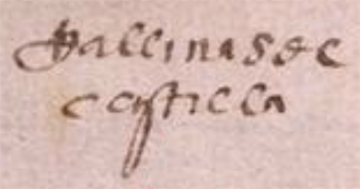
gallinas de castilla
Stephanie Wood
c. 1556
Jeff Haskett-Wood
pollo, tributo, tributos, resistencia, colonialismo, comida, flags, feathers, notación, números
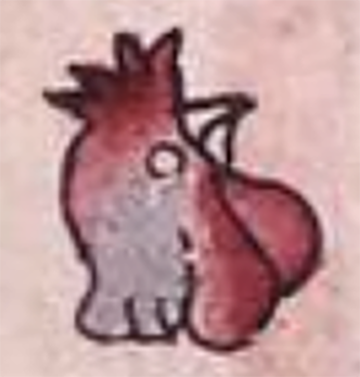
caxtil, chicken hen or rooster, https://nahuatl.wired-humanities.org/content/caxtil
la gallina de castilla
Stephanie Wood
The Codex Kingsborough, also known as the Códice de Tepetlaoztoc, and the Memorial de los indios de Tepetlaoztoc, is not on display. It was transferred from the British Library and is now held by the British Museum. It is shared on line at: https://www.britishmuseum.org/collection/object/E_Am2006-Drg-13964
©The Trustees of the British Museum. Shared under a Creative Commons Attribution-Non-Commercial-ShareAlike 4.0 International (CC BY-NC-SA 4.0) license. Please also cite the <em>Visual Lexicon of Aztec Hieroglyphsem>, ed. Stephanie Wood (Eugene, Ore.: Wired Humanities Projects, 2020-present) and this URL.