Chapol (MH519r)
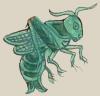
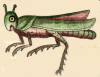
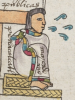
This simplex glyph for the personal name Chapol shows a grasshopper (chapolin) wearing a cape of turquoise blue and gold. The insect is shown in profile, facing toward the viewer's right. At least two bent legs are visible. The visible eye is open. Two antennae appear on the head.
Stephanie Wood
The chapolin (chapulín, in Spanish) enjoys a special place in history as the "most ancient living group of chewing herbivorous insects," and their existence dates back 250 million years, according to Ilan Stavans, A Pre-Columbian Bestiary (2020), 14. Today, the chapolin holds an important place in Mexican cuisine, especially prevalent in restaurants in Oaxaca.
The personal name Chapol is preceded in the gloss by a Christian first name, Toribio. This man may have been named after Toribio de Benavente, also known as Motolinia ("One Who is Poor or Afflicted"). Motolinia was the first word the friar learned in Nahuatl, and he went on to learn the language well. He lived in the monastery in Huejotzingo. Doing a quick search for the name "Toribio" will produce an impressive result.
As in the case of so many personal names, the absolutive ending (-in) of chapolin has dropped away. Despite this, the concept of grasshopper is not in doubt. Why this grasshopper wears a cape has yet to be determined, but elite Nahua men wore capes (called tilmatli, or tilmahtli with the glottal stop), so perhaps the cape adds prestige or preciosity. See the image for Petlacalcatl below.
Stephanie Wood
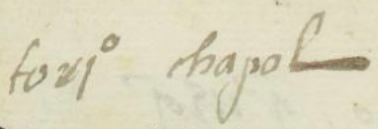
toro chapol
Toribio Chapol
Stephanie Wood
1560
José Aguayo-Barragán
chapulines, chapulín, grasshoppers, capes, capas, mantas
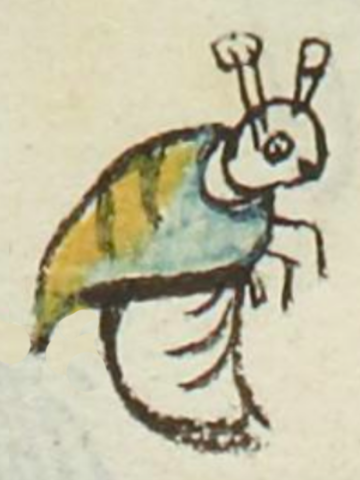
chapol(in), grasshopper, https://nahuatl.wired-humanities.org/content/chapolin
El Chapulín
Stephanie Wood
Matrícula de Huexotzinco, folio 519r, World Digital Library. https://www.loc.gov/resource/gdcwdl.wdl_15282/?sp=117&st=image
This manuscript is hosted by the Library of Congress and the World Digital Library; used here with the Creative Commons, “Attribution-NonCommercial-ShareAlike 3.0 License” (CC-BY-NC-SAq 3.0).