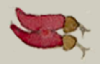
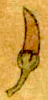
chilli (TK214v)
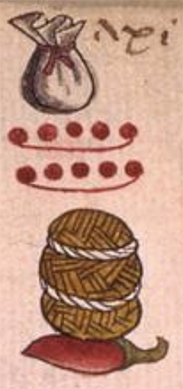
This painted simplex Nahuatl hieroglyph represents a chile pepper (chilli). It is glossed “axi” (modern ají), which supports the reading of chilli, even if the Nahuatl term does not appear on this manuscript page. The visual also aligns with various hieroglyphs already in this collection. The contextualizing image includes a notation for 80,000 (shown as a cloth sack tied at the top and typically called a xiquipilli, which is 8,000, then multiplied ten times). Also, the context shows that the chile peppers were bundled, wrapped in woven mats (what would be called petlatl), and tied with a twisted white cord or rope in two places.
Stephanie Wood
This enormous quantity of chile peppers was demanded by the Spanish encomendero (holder of the grant to exact tributes in kind and in labor), and this manuscript was produced as part of the community’s resistance to the unreasonable taxation being demanded vis-a-vis the size of the community, especially as the population was declining as a result of diseases inadvertently brought over from Europe. Spaniards were not yet as enamored with chile peppers to eat all of them in their own kitchens, so the peppers were probably being sold in markets or sent to the mines to feed the workers there. This collection includes many examples of chile peppers, most of them red (when they have color, although many are simple black-line drawings). A small amount of digital restoration has been made on this particular chile pepper, given that the mat was partially covering it. See the contextualizing image for the original view.
Side Note: The folio numbers are not always clear in the copy published online by the British Museum. Marc Thouvenot gives this page the number K12_B in his TLACHIA digital collection, https://tlachia.iib.unam.mx/tepetlaoztoc/K12_B.
Stephanie Wood
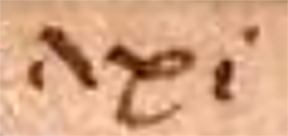
axi
ají
Stephanie Wood
c. 1556
Jeff Haskett-Wood
chiles, costal, costales, alforja, bolsa, tributo, tributos, colonialismo, resistencia

chil(li), chile pepper, https://nahuatl.wired-humanities.org/content/chilli
el chile
Stephanie Wood
The Codex Kingsborough, also known as the Códice de Tepetlaoztoc, and the Memorial de los indios de Tepetlaoztoc, is not on display. It was transferred from the British Library and is now held by the British Museum. It is shared on line at: https://www.britishmuseum.org/collection/object/E_Am2006-Drg-13964
©The Trustees of the British Museum. Shared under a Creative Commons Attribution-Non-Commercial-ShareAlike 4.0 International (CC BY-NC-SA 4.0) license. Please also cite the <em>Visual Lexicon of Aztec Hieroglyphsem>, ed. Stephanie Wood (Eugene, Ore.: Wired Humanities Projects, 2020-present) and this URL.