chiyantli (FCbk11f171r)
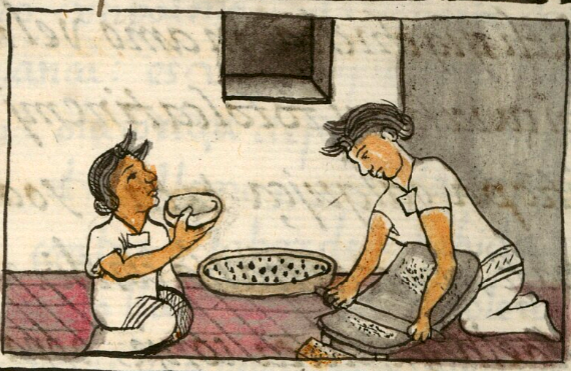
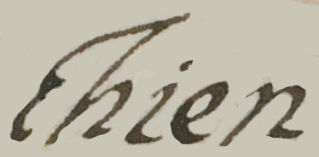
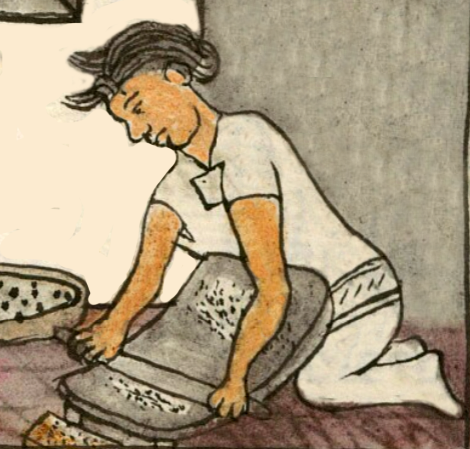
This iconographic example, featuring chia seeds (chiyantli), is included in this digital collection for the purpose of making comparisons with related hieroglyphs. The term selected for this example comes from the text near the image in the Digital Florentine Codex, even though the source does not include the absolutive ending (-tli). There is no gloss, per se. This example shows a woman grinding chia seeds on a grinding stone (metlatl) and using a hand-held grinding stone (metlapilli). The seeds are simple dots. The text notes that the seeds are called “chien” (a variant spelling), again without the absolutive. In fact, one rarely finds the noun bearing the absolutive that linguist Frances Karttunen asserts is there. She notes that Alonso de Molina does not use the absolutive, and she also admits that the intervocalic “y” is not 100% certain (and it is rare in textual attestations in our Online Nahuatl Dictionary). The contextualizing image shows one woman grinding and another holding a bowl that presumably contains some of the ground mixture. The text explains that these seeds are put in atolli, a maize gruel, that includes ground maize kernels, ground opossum tail, and water. Another mixture includes the chiyantli root and the root of the quetzalhuexotl. Women about to give birth were given these mixtures.
Stephanie Wood
The chiyantli seeds were also popular for extracting oil. The seeds appear in both place names and personal names, typically as black dots and as flowers or clusters of seeds at the top of a plant stalk, perhaps intending something like the Wikimedia example of salvia hispanica flowers. Folio 171v has a painting of the chiyantli plant. See some examples below.
Stephanie Wood
chien
chian or chiyantli
Stephanie Wood
1577
Jeff Haskett-Wood
chian, semillas, moler, mano, metate, comida, medicina, medicinas, mujer, mujeres
chiyan(tli), an edible seed with medicinal uses, https://nahuatl.wired-humanities.org/content/chiyantli
la chía
Stephanie Wood
Available at Digital Florentine Codex/Códice Florentino Digital, edited by Kim N. Richter and Alicia Maria Houtrouw, "Book 11: Earthly Things", fol. 171r, Getty Research Institute, 2023. https://florentinecodex.getty.edu/en/book/11/folio/171r/images/0 Accessed 16 November 2025.
Images of the digitized Florentine Codex are made available under the following Creative Commons license: CC BY-NC-ND (Attribution-NonCommercial-NoDerivs 4.0 International). For print-publication quality photos, please contact the Biblioteca Medicea Laurenziana ([email protected]). The Library of Congress has also published this manuscript, using the images of the World Digital Library copy. “The Library of Congress is unaware of any copyright or other restrictions in the World Digital Library Collection. Absent any such restrictions, these materials are free to use and reuse.”