cihuatl (Mdz63r)
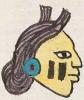
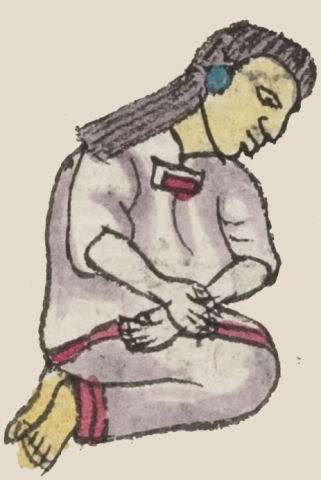
This iconographic example of a woman is meant to provide the basis for comparisons with glyphs for cihuatl. This woman is in a seated position with her legs under her (a classic posture). She is shown in profile, facing the viewer's right. She wears a skirt (cueitl) and a blouse (huipilli). The rectangle (pechero, in Spanish) over her chest is red and white, and the bottoms of both her blouse and her skirt are red. Otherwise the fabrics are white, probably cotton, with purple shading, white gives it a three-dimensionality. Her hands are in her lap, almost as though tied together. Her hair is long, reaching down her back. The skin on her face and feet are yellowish tan. Her arms are white. She has a turquoise earplug, which suggests some status.
Stephanie Wood
Este ejemplo iconográfico funge como la base de nuestras comparaciones con otros glifos para cihuatl: la mujer aparece de perfil, sentada sobre sus piernas dobladas (una postura muy común en los códices) y mirando hacia la derecha del espectador. Porta una falda (cueitl) y una blusa (huipilli) con un rectángulo rojo (llamado “pechero”), con los bordes inferiores de sus prendas también en rojo. El resto de las telas es blanco con sombreado morado, lo cual probablemente representa al algodón. El personaje mantiene las manos sobre su regazo, como si las tuviera atadas, y sus largos cabellos le caen sobre la espalda. Su rostro y sus pies aparecen de color amarillento, mientras que sus brazos son blancos, además de contar con una orejera de color turquesa.
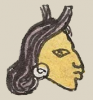
As a search of cihuatl would show, Nahua women in this collection typically appear with their hair tied up with two points pointing slightly above the top of the head. This may be an unmarried woman, given that her hair is long and down her back. Her posture is also abject, which results from the fact that she and a man had committed a sexual offense. The contextualizing image shows that he is being punished. Perhaps, she too, would be punished, which is why she is sad. Thus, this example of iconography could also be used here to represent tlaxini and tlaxximaliztli, two vocabulary words for adultery. (Note: the double x in the latter term requires further investigation.)
Stephanie Wood
Como puede verificarse mediante una búsqueda del término cihuatl, las mujeres nahuas en nuestra colección aparecen normalmente con sus cabellos atados con dos protuberancias que apuntan hacia arriba en la parte superior de las cabezas. La del presente ejemplo podría ser una soltera, dado que sus cabellos son largos y le caen sobre la espalda. Su postura es abyecta, debido al hecho de que ha cometido un delito sexual con un hombre, quien aparece en la imagen contextual recibiendo su castigo. Quizá la mujer está esperando su propio castigo, de ahí su expresión de tristeza. Por ello, este ejemplo iconográfico podría utilizarse para representar los términos tlaxini y tlaxximaliztli, que significan “adulterio”. Debemos investigar más a fondo la doble equis en el segundo término.
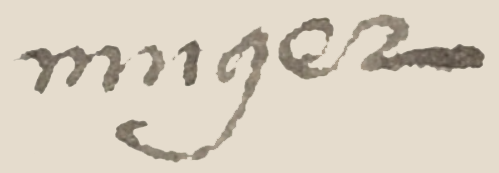
muger
mujer
Stephanie Wood
c. 1541, or by 1553 at the latest
Stephanie Wood
mujeres, women, punishment, castigos, adulterio, adúltera
cihua(tl), https://nahuatl.wired-humanities.org/content/cihuatl
tetlaxximaliz(tli), adultery, https://nahuatl.wired-humanities.org/content/tetlaxximaliztli
tlaxini, to commit adultery, https://nahuatl.wired-humanities.org/content/tlaxini
la mujer
Stephanie Wood
Codex Mendoza, folio 63 recto, https://digital.bodleian.ox.ac.uk/objects/2fea788e-2aa2-4f08-b6d9-648c00..., image 136 out of 188.
Original manuscript is held by the Bodleian Libraries, University of Oxford, MS. Arch. Selden. A. 1; used here with the UK Creative Commons, “Attribution-NonCommercial-ShareAlike 3.0 License” (CC-BY-NC-SA 3.0)