coyametl (FCbk12fir)
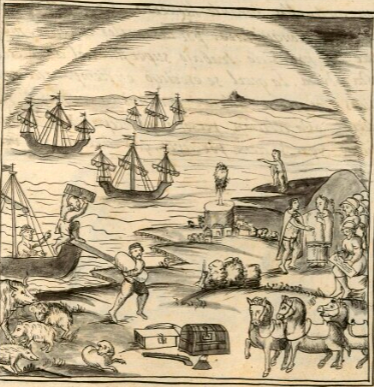
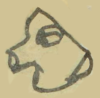
This iconographic example, featuring a black and white sketch of pig (coyametl), is included in this digital collection for the purpose of making comparisons with related hieroglyphs. There is no gloss, per se, and there is no reference to this animal in the nearby text of the Florentine Codex. This example shows a profile view of a peccary (probably a pig that recently was boarded off one of the nearby Spanish ships that appear in the contextualizing image). Peccaries existed in Mesoamerica in pre-contact times, but pigs were brought across the Atlantic and caught on in a big way in some Nahua communities for their meat. This pig has a long snout, and it may be a fang that emerges from the corner of its mouth. Its coat is textured, and it appears to have hooves. The landscape setting and the hatch marks that create a three-dimensionality are European artistic techniques that were learned by Nahua tlacuilos.
Stephanie Wood
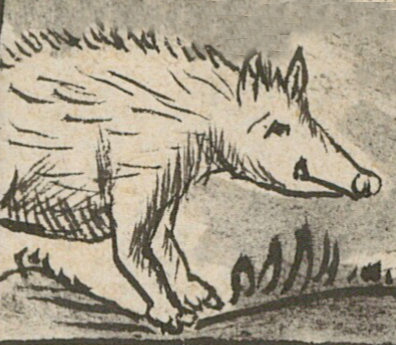
One peccary that appears in a compound hieroglyph in the Codex Mendoza (below), also shows hooves, a textured coat, and (in this case, multiple) fangs. This collection also includes another iconographic example of a coyametl from the Florentine Codex (also below). The tail is visible in that one, with its emblematic curl. Another term for a peccary in Nahuatl was pitzotl. Finally, pig-like snouts appears on the glyph for a person named Timocihui and on a tlacatecolotl.
Stephanie Wood
1577
Jeff Haskett-Wood
cerdos, pecarí, pecaríes, animales, carne, carnes, nacatl, pitzotl
coyame(tl), a peccary, https://nahuatl.wired-humanities.org/content/coyametl
el cerdo
Stephanie Wood
Available at Digital Florentine Codex/Códice Florentino Digital, edited by Kim N. Richter and Alicia Maria Houtrouw, "Book 12: Conquest of Mexico", fol. ir, Getty Research Institute, 2023. https://florentinecodex.getty.edu/en/book/12/folio/ir/images/0 Accessed 7 February 2026.
Images of the digitized Florentine Codex are made available under the following Creative Commons license: CC BY-NC-ND (Attribution-NonCommercial-NoDerivs 4.0 International). For print-publication quality photos, please contact the Biblioteca Medicea Laurenziana ([email protected]). The Library of Congress has also published this manuscript, using the images of the World Digital Library copy. “The Library of Congress is unaware of any copyright or other restrictions in the World Digital Library Collection. Absent any such restrictions, these materials are free to use and reuse.”