cuauhcamotli (FCbk11f125v)
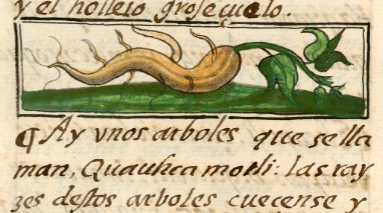
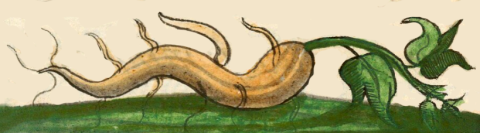
This iconographic example, featuring a cassava plant (cuauhcamotli, or cuauhcamohtli, with the glottal stop), is included in this digital collection for the purpose of making comparisons with related hieroglyphs. The term selected for this example comes from the text near the image in the Digital Florentine Codex. There is no gloss, per se. This example shows an orange, horizontal cassava root with attached stem and green leaves. Coming off this large root are smaller ones, some with some edible thickness, but the rest just hair-like roots. The text explains that this is edible and tastes something like another American root vegetable, the batata (sweet potato), which originated in the Amazon. The camote appears in a landscape setting. This setting, along with the shading that provides a three-dimensionality to the scene, reveal European artistic influence.
Stephanie Wood
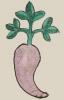
There is one camotli (not specified as a cuauhcamotli) already in this digital collection (as of November 2025). This one is a lavender color. See below.
Stephanie Wood

Quauhcamotli
cuauhcamotli
Stephanie Wood
1577
Jeff Haskett-Wood
raíces, raíz, verdura con almidón, tubérculo, tubérculos, camotes, batatas
cuauhcamo(tli), a cassava, https://nahuatl.wired-humanities.org/content/cuauhcamotli
el camote
Stephanie Wood
Available at Digital Florentine Codex/Códice Florentino Digital, edited by Kim N. Richter and Alicia Maria Houtrouw, "Book 11: Earthly Things", fol. 125v, Getty Research Institute, 2023. https://florentinecodex.getty.edu/en/book/11/folio/125v/images/0 Accessed 16 October 2025.
Images of the digitized Florentine Codex are made available under the following Creative Commons license: CC BY-NC-ND (Attribution-NonCommercial-NoDerivs 4.0 International). For print-publication quality photos, please contact the Biblioteca Medicea Laurenziana ([email protected]). The Library of Congress has also published this manuscript, using the images of the World Digital Library copy. “The Library of Congress is unaware of any copyright or other restrictions in the World Digital Library Collection. Absent any such restrictions, these materials are free to use and reuse.”