cuauhtli (TK220r)
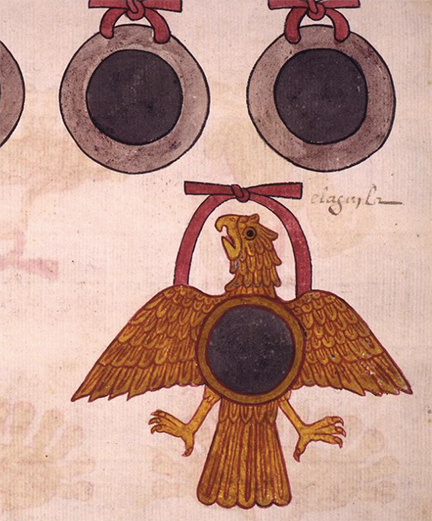
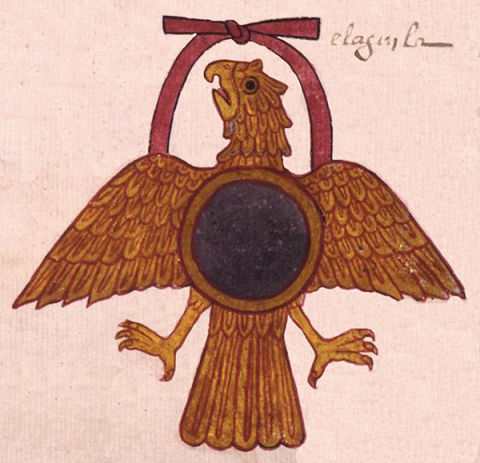
This painted example of iconography features an eagle (cuauhtli) as the central design on a piece of gold jewelry. The eagle has its wings spread. Its head is shown in profile facing left. Its hooked beak is open, as is its visible eye. Its claws are spread out and open. On its back appears to be a round, polished, obsidian mirror with perhaps a wooden frame around it. The piece has a large red (perhaps leather) tie at the top, so that it could be worn. This strap or tie goes completely around the neck and head of the cuauhtli. The bird’s feathers are drawn individually, with great detail. The feathers on the back of the eagle’s head stand out a little bit.
Stephanie Wood
The mirror was a device of importance to Nahua priests, who could use it for divining purposes, being able to see through it to divine forces and ancestors. A website about the 2010-2011 exhibition of Mesoamerican mirrors at the Getty Research Institute describes some of these features of the mirror. Eagles, of course, are key symbols that connect with the sun, divine power, and prowess on the battlefield. See this Mexicolore article, “Eagles,” for more information about eagles in Nahua culture.
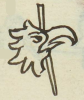
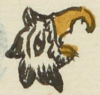
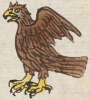
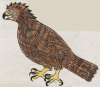
Below, in the comparison pieces, note how the eagle’s head can serve quite simply as the hieroglyph. The feathers on the back of the head are spiky, and the eagle’s beak is often hooked. When the bird’s whole body is shown, it is still usually in profile. Its wings will sometimes be raised, but not always. This view above, which is from behind, with the wings being spread, is somewhat unusual in the iconography of hieroglyphs.
Stephanie Wood
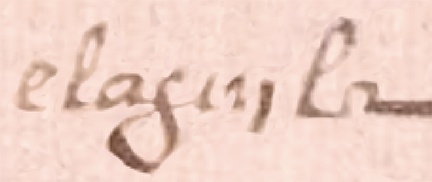
elaguila
el águila
Stephanie Wood
c. 1556
Jeff Haskett-Wood
joya, joyas, oro, águilas, espejo, espejos, atado, colgante, plumas
cuauh(tli), eagle, https://nahuatl.wired-humanities.org/content/cuauhtli
el águila
Stephanie Wood
The Codex Kingsborough, also known as the Códice de Tepetlaoztoc, and the Memorial de los indios de Tepetlaoztoc, is not on display. It was transferred from the British Library and is now held by the British Museum. It is shared on line at: https://www.britishmuseum.org/collection/object/E_Am2006-Drg-13964
©The Trustees of the British Museum. Shared under a Creative Commons Attribution-Non-Commercial-ShareAlike 4.0 International (CC BY-NC-SA 4.0) license. Please also cite the <em>Visual Lexicon of Aztec Hieroglyphsem>, ed. Stephanie Wood (Eugene, Ore.: Wired Humanities Projects, 2020-present) and this URL.