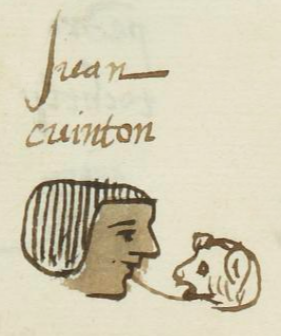
Cuinton (MH509r)
This black-line drawing of the simplex Nahuatl hieroglyph for the personal name Cuinton (here, attested as a man's name) shows the head of a dog (itzcuintli) in profile looking toward the viewer's left. Its coat is somewhat textured, its ears are up, and its mouth is open. The line indicating its nose has a little curve to it.
Stephanie Wood
Este dibujo de trazos negros del jeroglífico simple náhuatl utilizado para designar el nombre propio Cuinton se registra aquí como el nombre de un hombre. Nos muestra la cabeza de un perro (itzcuintli) de perfil que mira hacia la izquierda del espectador y que cuenta con un pelaje de aparente textura, orejas paradas y boca abierta, mientras que la línea que indica su nariz aparece ligeramente curvada.
The diminutive suffix on the name (-ton) could be built into the relative size (visually) of this image, but without a comparison, that is difficult to assess. These dogs were small as a rule, nothing like the size of the dogs brought to Mesoamerica by the Europeans. People still today will refer to small children, affectionately, as itzcuintli. The itzcuintli is a day sign in the calendar, so it is not unusual to see variations on the word for names (as here, where the itz- has dropped away). According to twentieth-century ethnography, a nahualli could take the shape of a dog. See: Los cuentos en náhuatl de Doña Luz Jiménez, recop. Fernando Horcasitas and Sarah O. de Ford (México, UNAM, 1979), 32–33.
Stephanie Wood
El sufijo diminutivo del nombre (-ton) podría interpretarse de acuerdo con el tamaño relativo (visual) de la imagen, pero esto no es fácil sin otra imagen para comparar. En general, estos canes eran de pequeño tamaño, al contrario de los perros que los europeos llevaron a Mesoamérica. En la actualidad, todavía hay gente que se refiere con cariño a sus niños pequeños como itzcuintli. El itzcuintli era un signo de día calendárico, por lo cual no es sorprendente encontrar variantes del término utilizadas como nombres, tal como en este caso en el que se ha perdido el prefijo itz-. Según algunos estudios etnográficos del siglo XX, un nahualli podía asumir la forma de un perro: véase Los cuentos en náhuatl de Doña Luz Jiménez, recopilación de Fernando Horcasitas y Sarah O. de Ford (México: UNAM, 1979, pp. 32–33).
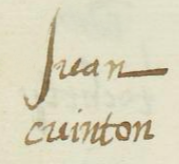
Juan
cuinton
Juan Cuinton
Stephanie Wood
1560
Jeff Haskett-Wood
dogs, perros, perritos, diminutivo, nombres de hombres, men's names
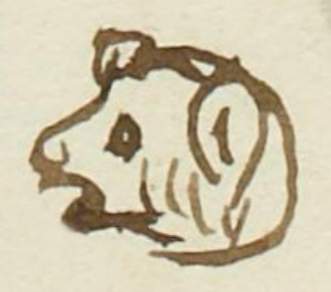
itzcuin(tli), dog, https://nahuatl.wired-humanities.org/content/itzcuintli
-ton(tli), diminutive suffix, https://nahuatl.wired-humanities.org/content/tontli
El Perrito
Stephanie Wood
Matrícula de Huexotzinco, folio 509r, World Digital Library, https://www.loc.gov/resource/gdcwdl.wdl_15282/?sp=97&st=image
This manuscript is hosted by the Library of Congress and the World Digital Library; used here with the Creative Commons, “Attribution-NonCommercial-ShareAlike 3.0 License” (CC-BY-NC-SAq 3.0).