Huitzilopochtli (FCbk12f30v)
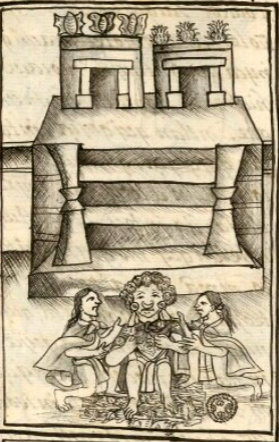
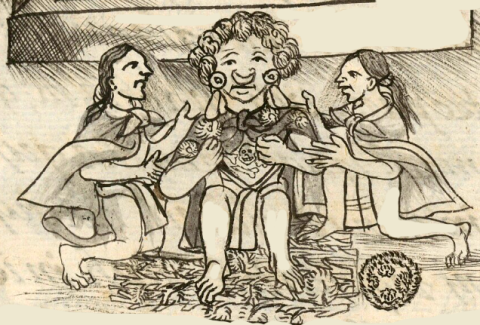
This iconographic example features a black and white sketch of an amaranth statue of the divine force Huitzilopochtli in a frontal view. He is flanked by two men with long hair in ponytails. It is included in this digital collection for the purpose of making comparisons with related hieroglyphs. The term selected for this example comes from the page preceding the image in the Digital Florentine Codex, but it is only found on that page in the Spanish-language text, not the Nahuatl text. There is no gloss, per se. This example shows a frontal view of the divine force relating to war. It is made from fish amaranth dough (tzohualli) that was ground and prepared by Nahua women according to both texts and images. The figure has shaggy hair on its head, a pattern of skulls and bones on his cloak, a loincloth, and bare feet resting on what is likely some greenery. The Nahuatl text explains all his accoutrements in great detail, including his turquoise earrings, a hammered gold nose ornament (probably a yacametztli, given its crescent shape), and a hummingbird totem on his head (among other things). The contextualizing image shows the principal temple of Mexico-Tenochtitlan, with its paired buildings on top, each one with unique designs on the roof. The following pages have several more images of Huitzilopochtli.
Stephanie Wood
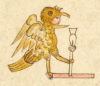
In Nahuatl hieroglyphs, the name of the sacred force of Huitzilopochtli is typically represented at least in part as a hummingbird (huitzilin).
Stephanie Wood
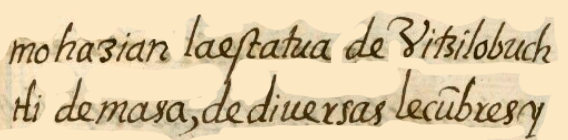
Vitzilobuchtli
Huitzilopochtli
Stephanie Wood
1577
Jeff Haskett-Wood
amaranto, turquesas, fuerzas divinas, fuerzas sagradas, nombres de deidades, guerra, sol, lluvia
Huitzilopochtli, a divine force related to war, the sun, and the rain, https://nahuatl.wired-humanities.org/content/huitzilopochtli
Huitzilopochtli, nombre de una deidad o fuerza divina
Stephanie Wood
Available at Digital Florentine Codex/Códice Florentino Digital, edited by Kim N. Richter and Alicia Maria Houtrouw, "Book 12: Conquest of Mexico", fol. 30v, Getty Research Institute, 2023. https://florentinecodex.getty.edu/en/book/12/folio/30v/images/0 Accessed 7 February 2026.
Images of the digitized Florentine Codex are made available under the following Creative Commons license: CC BY-NC-ND (Attribution-NonCommercial-NoDerivs 4.0 International). For print-publication quality photos, please contact the Biblioteca Medicea Laurenziana ([email protected]). The Library of Congress has also published this manuscript, using the images of the World Digital Library copy. “The Library of Congress is unaware of any copyright or other restrictions in the World Digital Library Collection. Absent any such restrictions, these materials are free to use and reuse.”