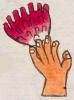
maitl (Mdz12r)
This element for hand (maitl or matl) has been carved from the compound sign for the place name, Tamapachco (see below). This is a left hand is upright (vertical), and it is painted with a terracotta or flesh tone. The fingernails are visible, and they are white.
Stephanie Wood
Este elemento que representa una mano (maitl o matl) se ha extraído del signo compuesto para el topónimo Tamapachco (véase más abajo) y nos muestra una mano izquierda en posición vertical de color ocre o rosáceo, en la cual se aprecian las uñas blancas.
The hand, with the phonetic value of "ma," could be considered part of the mapachin construction, and it serves as a phonetic clue to that word. A mapachin, raccoon, is considered a thief, and the name Mapachin therefore also takes on the meaning of thief. Since a thief is one who takes or steals, the hand in the original compound can double as the verb ma (take, capture). In the original compound, the hand is reaching to take a tapachtli, a piece of coral (see below, right). So, there is the syllable "pach," once again. According to Gordon Whittaker, we should pay attention to the upright hand without an arm attached versus the more horizontal or diagonal arm, which can have readings other than maitl), such as the "ma" of capture, "ana" of grab, or "poloa" of destroy. (Deciphering Aztec Hieroglyphs, 2021, 104) In this case, we do have an upright hand without an attached arm, and it is still trying to take something, perhaps pointing to the verb mapachoa (to take or seize something).
Stephanie Wood
Al contar con el valor fonético de “ma”, la mano puede considerarse como parte del término mapachin, por lo que funge como un indicador fonético de dicha palabra. Se creía que los mapachin (mapaches) eran ladrones, por lo que el nombre propio Mapachin también adquiría ese significado. Dado que un ladrón roba o sustrae los bienes ajenos, la mano en el jeroglífico original puede fungir como el verbo ma (tomar o capturar). En dicho jeroglífico, la mano se extiende para aferrar un tapachtli, un trozo de coral (véase abajo a la derecha): nos encontramos de nuevo con la sílaba “pach”. Según Gordon Whittaker, debemos prestar más atención a una mano erguida sin brazo que a una mano con un brazo horizontal o diagonal, la cual puede tener otras interpretaciones que no sean maitl, tales como el “ma” de captura, el “ana” de aferrar o el “poloa” de destruir (Deciphering Aztec Hieroglyphs, 2021, p. 104). En este caso contamos con una mano erguida sin brazo que aun así intenta aferrar algo, lo cual quizá indica el verbo mapachoa (tomar o apoderarse de algo).
c. 1541, but by 1553 at the latest
Stephanie Wood
hands, manos
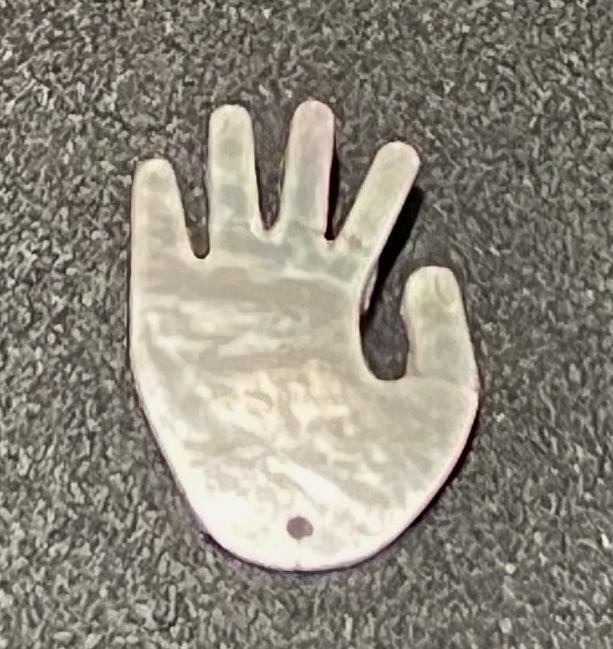
maitl. Mother-of-pearl hand, Museo del Templo Mayor. Photograph by Robert Haskett, 15 February 2023.
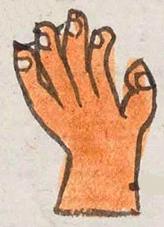
ma(itl), hand or arm, https://nahuatl.wired-humanities.org/maitl
ma(tl), hand, a measurement, https://nahuatl.wired-humanities.org/matl
mapachoa to take or seize, https://nahuatl.wired-humanities.org/content/mapachoa
ma, take or capture, https://nahuatl.wired-humanities.org/ma-0
thief
la mano
Stephanie Wood
Codex Mendoza, folio 12 recto, https://digital.bodleian.ox.ac.uk/objects/2fea788e-2aa2-4f08-b6d9-648c00..., image 34 of 188.
The Bodleian Libraries, University of Oxford, hold the original manuscript, the MS. Arch. Selden. A. 1. This image is published here under the UK Creative Commons, “Attribution-NonCommercial-ShareAlike 3.0 License” (CC-BY-NC-SA 3.0).