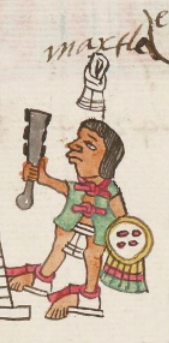
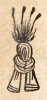
Maxtla (TR31r)
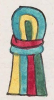
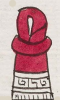
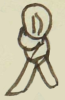
This black-line drawing of the simplex glyph from the Codex Telleriano-Remensis for the personal name Maxtla (here, attested as a man’s name) shows a frontal view of a white loincloth (maxtlatl) with a loop, a knot, and horizontal lines across the two hanging pieces.
Stephanie Wood

maxtla
Maxtla
Stephanie Wood
ca. 1550–1563
Jeff Haskett-Wood
breechclouts, loincloths, taparrabos, bragas, nombres de hombres
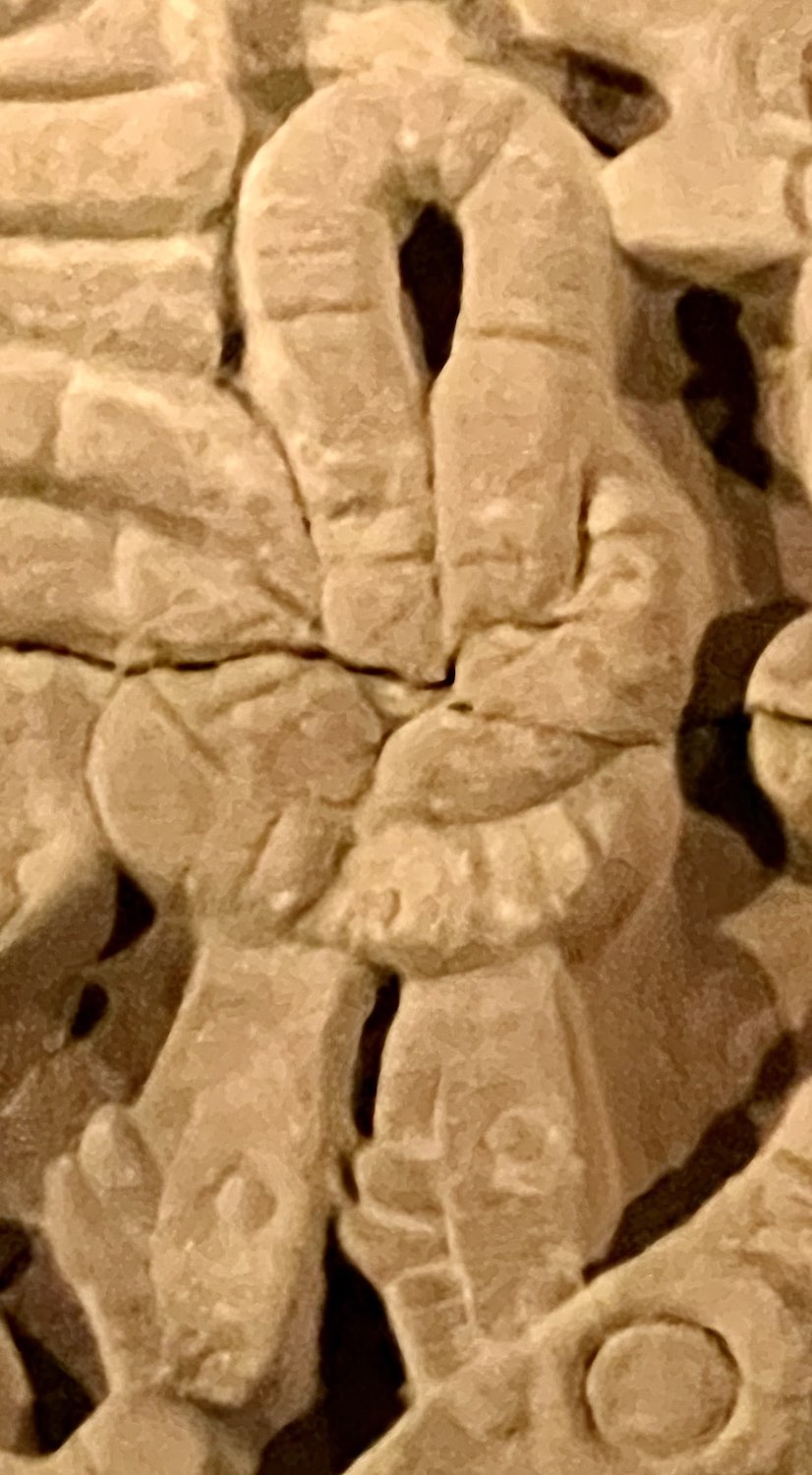
This is a detail of the sculptured stone depicting Coyolxauhqui (the divine force of the moon and sister of Huitzilopochtli). It shows loincloth, a male garment, with the classic loop and knot, with the exception that it involves snakes. Louise M. Burkhart suggests this loincloth connects Coyolxauhqui to warfare. [See: “Mexican Women on the Home Front,” p. 47, in Susan Schroeder, Stephanie Wood, and Robert Haskett, eds., Indian Women of Early Mexico (1997, 25–54).] Photograph by Stephanie Wood, Museo del Templo Mayor, Mexico City, 15 February 2023.
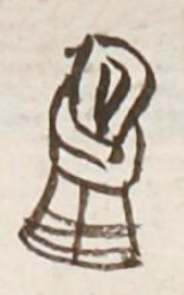
maxtla(tl), loincloth, https://nahuatl.wired-humanities.org/content/maxtlatl
Taparrabo
Stephanie Wood
Telleriano-Remensis Codex, folio 31 recto, MS Mexicain 385, Gallica digital collection, https://gallica.bnf.fr/ark:/12148/btv1b8458267s/f87.item.zoom
The non-commercial reuse of images from the Bibliothèque nationale de France is free as long as the user is in compliance with the legislation in force and provides the citation: “Source gallica.bnf.fr / Bibliothèque nationale de France” or “Source gallica.bnf.fr / BnF.”