Miquiz (Verg40r)
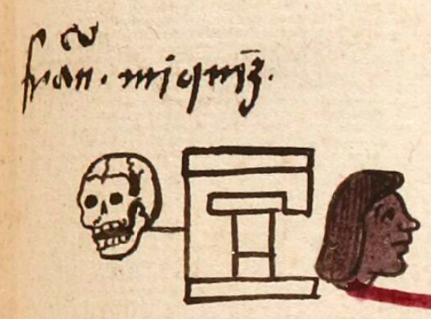
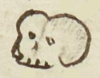
This simplex Nahuatl hieroglyph is a black-line drawing of the personal name Miquiz (“Death), which is attested here as a man’s name. It shows a skull in a ¾ view, looking toward the left. Its mouth is open, with seven white teeth visible against a very black opening. The eye and nose cavities are also black. The blackness in the mouth just might suggest there is an obsidian blade (itztli) in the mouth, which would add a phonetic complement in the way of the final sound in the name -iz. The presence of several obsidian pieces may be what is next to the skull in the rendition of the Miquiz hieroglyph in the Vergara on folio 44v.
Stephanie Wood
Miquiztli (death) is a day sign in the 260-day divinatory calendar called the tonalpohualli. We do not have the numerical value that would have accompanied the death day sign, a number from 1 to 13. The number may have been suppressed to disguise the name's association with the divinatory calendar, which the colonial clergy were trying to stamp out.
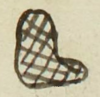
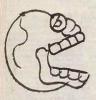
The iconography of miquiztli and related words will vary considerably across manuscripts. One example, below, is very colorful. It is from the Telleriano-Remensis Codex. The glyph (Mdz43r) shown below for the verb "to die" (miqui) has what is called a starry or stellar eye, which associates it with the celestial realm. A very similar glyph can be seen in use for the name Cocoliz (short for cocoliztli, disease), too Calendrics were important in the Nahuas' religious view of the cosmos.
Stephanie Wood
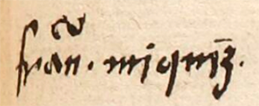
franco. miquiz.
Francisco Miquiz
Stephanie Wood
1539
Jeff Haskett-Wood
nombres de hombres, men’s names, muerte, morir, muerto, cráneo, calendario, calendarios, nombres de días
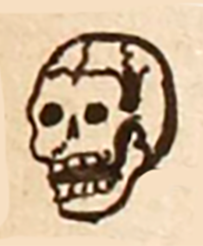
miquiz(tli), death, https://nahuatl.wired-humanities.org/content/miquiztli
Muerte
Stephanie Wood
Available at Codex Vergara, folio 40r, https://gallica.bnf.fr/ark:/12148/btv1b84528032/f87.item.zoom, accessed 10 March 2026. The Vergara is associated with Tepetlaoztoc, in the larger region of Tetzcoco, c. 1539–1543. “Source gallica.bnf.fr / BnF.” We would also appreciate a citation to the Visual Lexicon of Aztec Hieroglyphs, https://aztecglyphs.wired-humanities.org/.
Image Rights: The non-commercial reuse of images from the Bibliothèque nationale de France is free as long as the user is in compliance with the legislation in force and provides the citation: “Source gallica.bnf.fr / Bibliothèque nationale de France” or “Source gallica.bnf.fr / BnF.” We would also appreciate a citation to the Visual Lexicon of Aztec Hieroglyphs, https://aztecglyphs.wired-humanities.org/