Ohua (Verg33v)
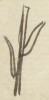
his simplex Nahuatl hieroglyph is a black-line drawing of the personal name Ohua, apparently the apocopated version of ohuatl, a green maize stalk. It is attested here as a man’s name. It shows a maize stalk with four leaves and a tassel at the top that curves off to the left. This simplex is practically identical to the hieroglyph for Ohua (written there as Ohuan, with the intrusive -n) that appears on folio 36 recto.
Stephanie Wood
Ohua, Ohuaton, and Ohuatl are all personal names found in the Matrícula de Huexotzinco, and ohuatl also plays a role in one place name, Ohuapan (Mdz37r). The iconography of ohuatl can have maize cobs, but it most typically has tassels (flowers). Because ohuatl can also refer to cane, sometimes it is shown as segmented.
Stephanie Wood

jua. ohua.
Juan Ohua
Stephanie Wood
1539
Jeff Haskett-Wood
tallos, borlas de maíz, mazorca, mazorcas, nombres de hombres, men’s names

oahua(tl), a green maize stalk, https://nahuatl.wired-humanities.org/content/ohuatl
Tallo de Maíz Verde
Stephanie Wood
Available at Codex Vergara, folio 33v, https://gallica.bnf.fr/ark:/12148/btv1b84528032/f74.item.zoom, accessed 1 March 2026. The Vergara is associated with Tepetlaoztoc, in the larger region of Tetzcoco, c. 1539–1543. “Source gallica.bnf.fr / BnF.” We would also appreciate a citation to the Visual Lexicon of Aztec Hieroglyphs, https://aztecglyphs.wired-humanities.org/.
Image Rights: The non-commercial reuse of images from the Bibliothèque nationale de France is free as long as the user is in compliance with the legislation in force and provides the citation: “Source gallica.bnf.fr / Bibliothèque nationale de France” or “Source gallica.bnf.fr / BnF.” We would also appreciate a citation to the Visual Lexicon of Aztec Hieroglyphs, https://aztecglyphs.wired-humanities.org/