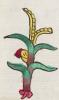
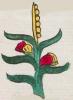
ohuatl (TK224v)
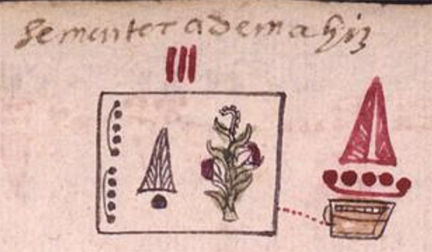
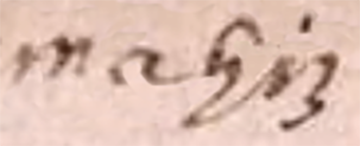
This painted simplex Nahuatl hieroglyph represents a green maize stalk (ohuatl) with two ears of corn (what could be called xilotl) and a tassel (what could be called miyahuatl) at the top of the plant. While the Spanish gloss refers to this plant as “mahiz” (maize), this glyph is very similar to the ohuatl glyph in the Codex Mendoza. Here, the leaves are green, and the ears of corn are white with red silk. The contextualizing image shows how this plant is painted within a rectangle that represents an agricultural field (called a “sementera” in the Spanish gloss). The notations show that three such fields were expected to produce 2,000 measures (probably fanegas) of kernels that had to be presented in tribute (a type of taxation) to the Spanish overlord whose name was Espinosa (or Espinoza). This same man also required lots of wheat grain, gold discs, and other food and household goods. The people of Tepetlaoztoc protested his demands and his abuse of the local people. He is portrayed on this same page beating a man with a stick, drawing blood from his nose and his rear end. He is also pulling his hair, which is a grave insult, dishonor, and cause of intense emotion. Sonya Lipsett-Rivera writes about the ritual humiliation of hair pulling in Religion in New Spain, eds. Susan Schroeder and Stafford Poole (2007), 79.
Stephanie Wood
A maize plant could also be called a toctli (below), and the maize field could be a milli (which later became milpa) or tlalli.
Side Note: The folio numbers are not always clear in the copy published online by the British Museum. Marc Thouvenot gives this page the number K22_B in his TLACHIA digital collection, https://tlachia.iib.unam.mx/tepetlaoztoc/K22_B
Stephanie Wood
mahiz
maíz
Stephanie Wood
c. 1556
Jeff Haskett-Wood
plantas, tlaolli, elotl, xilotl, amilli, miyahuatl, cintli, centli, cacamatl, granos, abusos, tributos, encomendero, encomenderos, resistencia, colonialismo
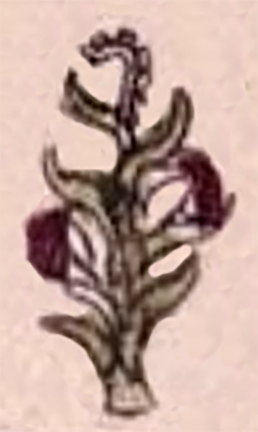
ohua(tl), green maize stalk, https://nahuatl.wired-humanities.org/content/ohuatl
la caña de maíz verde
Alonso de Molina
The Codex Kingsborough, also known as the Códice de Tepetlaoztoc, and the Memorial de los indios de Tepetlaoztoc, is not on display. It was transferred from the British Library and is now held by the British Museum. It is shared on line at: https://www.britishmuseum.org/collection/object/E_Am2006-Drg-13964
©The Trustees of the British Museum. Shared under a Creative Commons Attribution-Non-Commercial-ShareAlike 4.0 International (CC BY-NC-SA 4.0) license. Please also cite the <em>Visual Lexicon of Aztec Hieroglyphsem>, ed. Stephanie Wood (Eugene, Ore.: Wired Humanities Projects, 2020-present) and this URL.