Omitl (BMapO103)
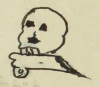
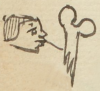
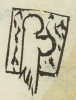
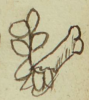
This black-line drawing of the simplex glyph for the personal name Omitl (“Bone”) is attested here as a man’s name. The glyph shows what may be two (ome) downward-pointing spines. These objects have a remnant of turquoise blue paint on them. Perhaps they are meant to be bones (omitl), but they do not have a standard bone shape. So, the number two (ome) may be a phonetic indicator for the name that starts with Om-.
Stephanie Wood
Further consultation is required for this record, but many bone signs have a sharp point at one end.
Stephanie Wood
This glyph is not glossed; the transliteration of the glyph comes from Gordon Whittaker’s contribution to the study by Mary E. Miller and Barbara E. Mundy (2012).
c. 1565
Jeff Haskett-Wood
huesos, números, dos, nombres de hombres, hueso
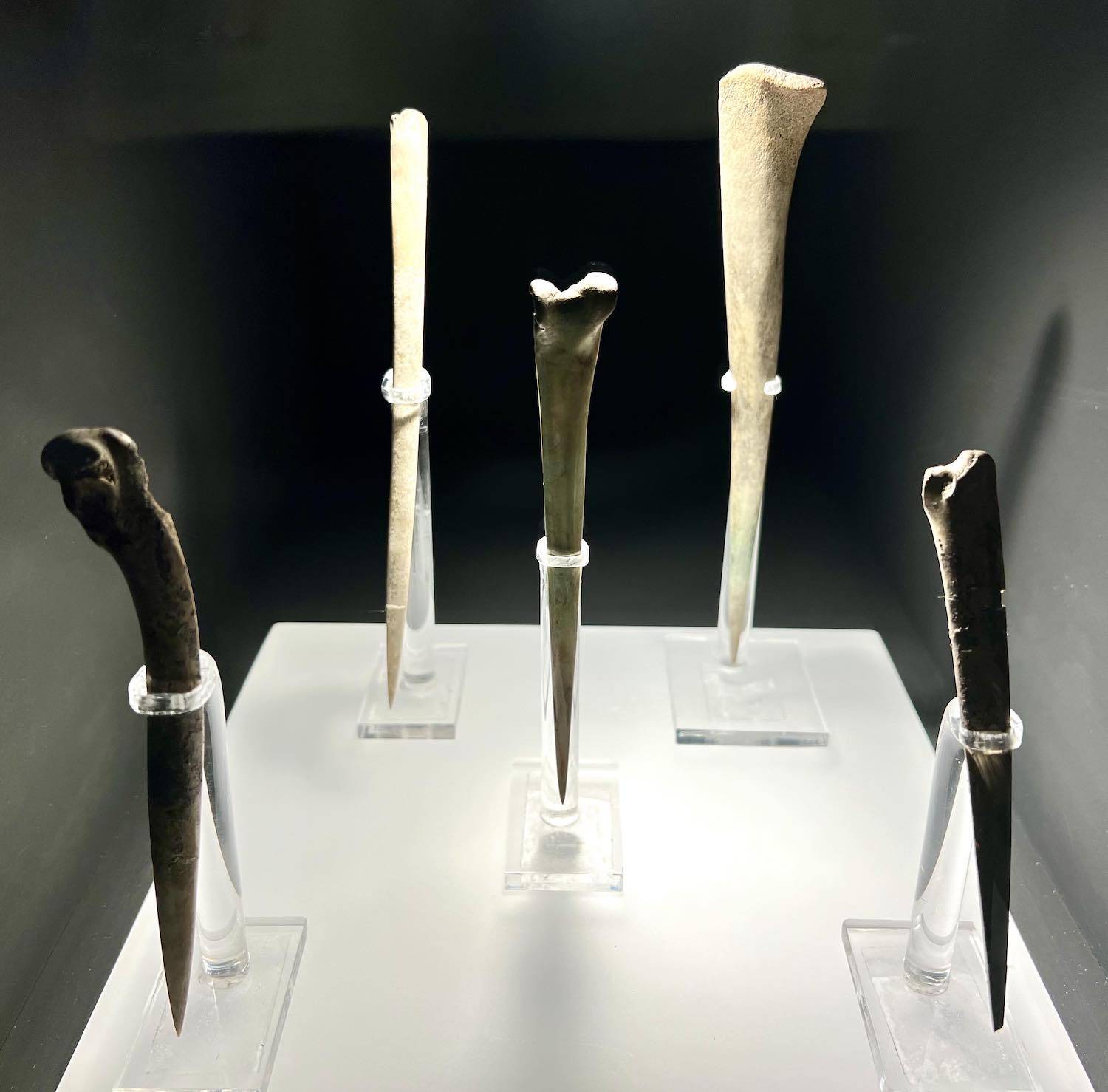
These elite, eagle and jaguar bone tools have pointed tips for poking holes, often for use in drawing blood for making religious offerings. People of the tribute-paying class used maguey thorns for the same purpose. Photograph by Stephanie Wood, Museo del Templo Mayor, Mexico City, 15 February 2023.
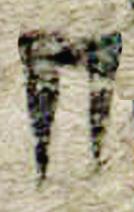
omi(tl), a bone, https://nahuatl.wired-humanities.org/content/omitl
ome, two, https://nahuatl.wired-humanities.org/content/ome
Hueso
Stephanie Wood
Beinecke Map/Codex Reese, section 8, no. 103 in the Whittaker study (published in the Miller/Mundy book, 2012), and see the original at: https://brbl-dl.library.yale.edu/vufind/Record/3600017
The Bodleian Libraries, University of Oxford, hold the original manuscript, the MS. Arch. Selden. A. 1. This image is published here under the UK Creative Commons, “Attribution-NonCommercial-ShareAlike 3.0 License” (CC-BY-NC-SA 3.0).