ozomatli (TK220v)
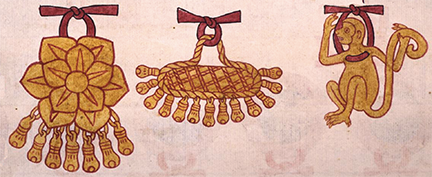
This painted example of iconography features a gold jewel in the form of a monkey (ozomatli). It is shown in full body, sitting, facing left. The red, perhaps leather, looping tie that would have been used to hang the jewel from one’s clothing or the like, cuts through the monkey’s body as though it is going under his arms. The monkey’s right hand reaches up near its face, and the left hand grasps the curling tail. The hands and feet have long nails. The curving lines around the face are a classic part of the iconography.
Stephanie Wood
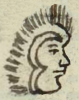
The ozomatli was a day sign in the religious divinatory calendar, the tonalpohualli, so many people had the name Ozoma. Examples appear below. A couple of differences between this monkey and the hieroglyphs is the way the monkey will sometimes wear an earring and the hair on its head will stand up or stick out. For an explanation of the significance of the ozomatli, see also Mexicolorea>. One notable feature of the monkey is the way it could perform the role of a nahualli (animal spirit associated with a human).
Stephanie Wood
c. 1556
Jeff Haskett-Wood
joya, joyas, oro, metales, piel, monos, nahualli, nahual, nahuales, jugar, juguetear, diablillo, diablillas, travesuras, golfillo, tributo, tributos, resistencia, colonialismo

ozoma(tli), monkey, https://nahuatl.wired-humanities.org/content/ozomatli
el mono
Stephanie Wood
The Codex Kingsborough, also known as the Códice de Tepetlaoztoc, and the Memorial de los indios de Tepetlaoztoc, is not on display. It was transferred from the British Library and is now held by the British Museum. It is shared on line at: https://www.britishmuseum.org/collection/object/E_Am2006-Drg-13964
©The Trustees of the British Museum. Shared under a Creative Commons Attribution-Non-Commercial-ShareAlike 4.0 International (CC BY-NC-SA 4.0) license. Please also cite the <em>Visual Lexicon of Aztec Hieroglyphsem>, ed. Stephanie Wood (Eugene, Ore.: Wired Humanities Projects, 2020-present) and this URL.