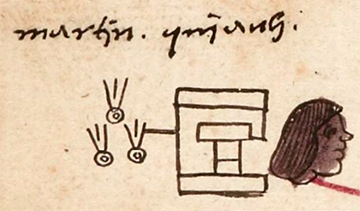
Quiyauh (Verg26v)
This simplex Nahuatl hieroglyph is a black-line drawing of the personal name Quiyauh (“Rain”), attested here as a man’s name. It shows three short streams of water (atl), each one rather triangular, with a line of current (movement) running down the middle, and a droplet (or bead) at the end. The droplet is a small circle with another circle inside. Multiple drops of water suggest rain (quiyahuitl). The name is apocopated.
Stephanie Wood
The name Quiyauh appears at least nine times in the Matrícula de Huexotzinco, showing how this Nahua name occurred across regions. Being a day sign in the 260-day religious divinatory calendar (the tonalpohualli) accounts for its broad popularity, along with the centrality of rain for subsistence agriculture. Water droplets were equated in some ways with the precious green stone (chalchihuitl), and some rain signs are painted a turquoise blue. Because this is a day sign, sometimes it is found with a numerical companion (from 1 to 13), which also came from the calendar. This practice, however, was likely suppressed to appease the colonial clergy, who tried to discourage the use of the old calendar. If this manuscript is as early as many believe, it would probably not be likely that this was a case of forgetting the iconography. Serious events in Tetzcoco in 1539 may have made Nahua tlacuilos more cautious when writing and painting about aspects of their faith. See Patricia Lopes Don for information about the Inquisition case against don Carlos Ometochtli, a Chichimecatecuhtli (or Chichimecateuctli) executed in late 1539, in Bonfires of Culture, 2010. Bradley Benton (The Lords of Tetzcoco, 2017, 46) also writes that the case “demonstrates that blatant disregard for Christianity had serious consequences.”
The tonalpohualli, being used for "prognostication and divination, had no parallel and contravened Christian dogma so its use was disavowed and prohibited." [See Rubén G. Mendoza, Ritual Human Sacrifice in Mesoamerica (2024), 439.] Nevertheless, calendrics were an important part of Nahuas' religious views of the cosmos, and this practice survived a long time under colonialism, even if in modified form.
Stephanie Wood
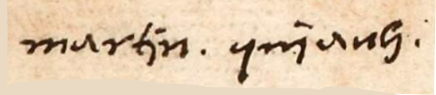
martín. quiauh.
Martín Quiyauh
Stephanie Wood
1539
Jeff Haskett-Wood
calendario, calendrics, dates, fecha, fechas, lluvia, gotas, agua, nombres de hombres, men’s names
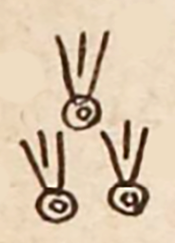
quiyahui(tl), the rain, a rainstorm, https://nahuatl.wired-humanities.org/content/quiyahuitl
La Lluvia
Stephanie Wood
Available at Codex Vergara, folio 26v,
https://gallica.bnf.fr/ark:/12148/btv1b84528032/f60.item.zoom, accessed 22 February 2026. The Vergara is associated with Tepetlaoztoc, in the larger region of Tetzcoco, c. 1539–1543. “Source gallica.bnf.fr / BnF.” We would also appreciate a citation to the Visual Lexicon of Aztec Hieroglyphs, https://aztecglyphs.wired-humanities.org/.
Image Rights: The non-commercial reuse of images from the Bibliothèque nationale de France is free as long as the user is in compliance with the legislation in force and provides the citation: “Source gallica.bnf.fr / Bibliothèque nationale de France” or “Source gallica.bnf.fr / BnF.” We would also appreciate a citation to the Visual Lexicon of Aztec Hieroglyphs, https://aztecglyphs.wired-humanities.org/