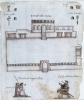
tecpancalli (FCbk11f240v-241r)
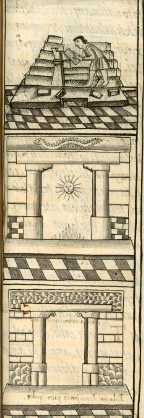
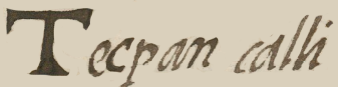
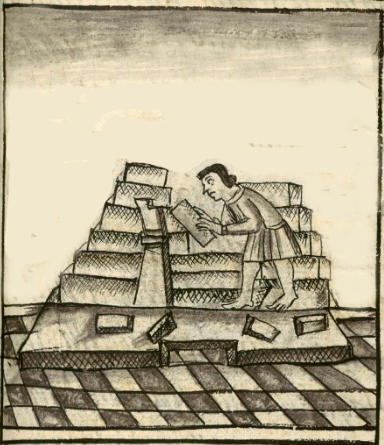
This iconographic example, featuring a black and white sketch of a man building a ruler’s palace (tecpancalli), is included in this digital collection for the purpose of making comparisons with related hieroglyphs. The term selected for this example comes from the page prior to the image in the Digital Florentine Codex. There is no gloss, per se. This example shows a Nahua man in profile, wearing a European-style belted tunic that reaches his knees. He is bent over slightly, facing left, holding a stone, that he is about to place on the building under construction. The pyramid is only about half built. The steps are shaded, giving them a three-dimensionality (a European artistic style). The foreground shows a paved floor with pieces of stone in alternating dark and light colors. At this point, the building seems little different from a teocalli (religious temple). But it would have some of its own unique features, such as carved stone and plaster, as described in the text.
Stephanie Wood
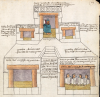
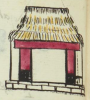
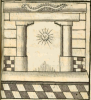
As of February 2026, we have few tecpancalli in this digital collection. One, from the Codex Mendoza, is not even glossed as a tecpancalli, although we assume it to be one. Another, a glossed hieroglyph from the Matrícula de Huexotzinco, has a red, wooden-framed entry way and a thatched roof. A “tecpan” from the Mendoza is shown in profile and looks much like a calli, has the added, significant feature of the water droplets or jade beads (chalchihuitl) that often appeared on palaces on the eaves. In the example here from the Florentine Codex, it is interesting that the term tecpancalli is divided into two words, perhaps another indication that “tecpan” could stand on its own.
Stephanie Wood
Tecpan calli
tecpancalli
Stephanie Wood
1577
Jeff Haskett-Wood
buildings, edificios, palaces, palacios, gobierno
tecpancal(li), ruler’s palace, government building, https://nahuatl.wired-humanities.org/content/tecpancalli
el palacio real
Stephanie Wood
Available at Digital Florentine Codex/Códice Florentino Digital, edited by Kim N. Richter and Alicia Maria Houtrouw, "Book 11: Earthly Things", fol. 241r, Getty Research Institute, 2023. https://florentinecodex.getty.edu/en/book/11/folio/241r/images/0 Accessed 16 November 2025.
Images of the digitized Florentine Codex are made available under the following Creative Commons license: CC BY-NC-ND (Attribution-NonCommercial-NoDerivs 4.0 International). For print-publication quality photos, please contact the Biblioteca Medicea Laurenziana ([email protected]). The Library of Congress has also published this manuscript, using the images of the World Digital Library copy. “The Library of Congress is unaware of any copyright or other restrictions in the World Digital Library Collection. Absent any such restrictions, these materials are free to use and reuse.”