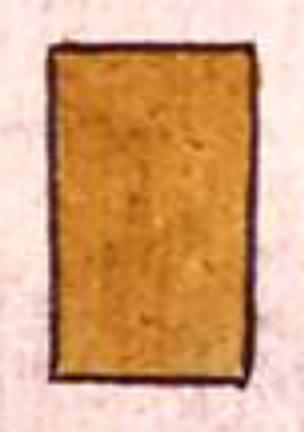
teocuitlatl (TK210r)
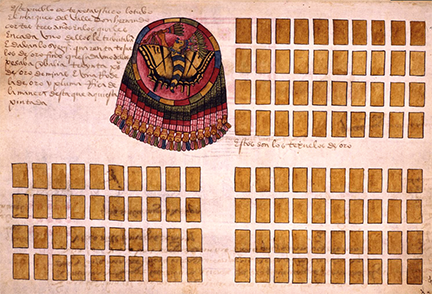
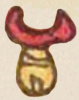
This painted simplex Nahuatl hieroglyph represents a piece of gold that was one of forty such items paid in each of three years to Hernando Cortés. It is yellow gold and rectangular. Each piece is said in the companion text to be worth 30 pesos, a very large quantity in that period. Cortés was in Mexico from the invasion of 1519 through 1540. This manuscript was produced as part of the community’s resistance through the court system to the unreasonable taxation being demanded vis-a-vis the size of the community, especially as the population was declining as a result of diseases inadvertently brought over from Europe.
Stephanie Wood
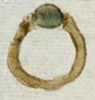
Golden objects, as expressed in the hieroglyphs represented in this collection, more often tend to be coins, bells, rings, and beads. But, this kind of object will also be found. As mentioned in our Online Nahuatl Dictionary, the Codex Mendoza refers to pieces of gold the “size of an oyster and the thickness of a finger” that were paid in tribute (colonial taxes). Our dictionary also includes Alonso de Molina’s reference to “coztic teocuitla tlatemantli,” which was a piece of yellow gold given in tribute. Both the glyph here from the Tepetlaoztoc codex and the translation in Molina’s dictionary use the term tejuelo to refer to this piece of gold. We are relying upon this information to go beyond calling this an example of iconography and instead calling it a hieroglyph. On folios 211r. and 212r, another term for the pieces of gold is given in the Spanish text: planchuelas de oro. On 212r., it is clear that these are flat and rectangular.
Side Note: The folio numbers are not always clear in the copy published online by the British Museum. Marc Thouvenot gives this page the number K08_A in his TLACHIA digital collection, https://tlachia.iib.unam.mx/tepetlaoztoc/K08_A.
Stephanie Wood
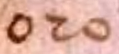
oro (the Spanish word for gold, also a loanword in Nahuatl)
Stephanie Wood
c. 1556
Jeff Haskett-Wood
joya, joyas, amarillo, tributo, tributos, colonialismo, resistencia
coztic, yellow, https://nahuatl.wired-humanities.org/content/coztic
teocuitla(tl), gold, https://nahuatl.wired-humanities.org/content/teocuitlatl
coztic teocuitla tlatemantli, a piece of yellow gold, https://nahuatl.wired-humanities.org/content/coztic-teocuitla-tlatemantli
tejuelo de oro
Stephanie Wood
The Codex Kingsborough, also known as the Códice de Tepetlaoztoc, and the Memorial de los indios de Tepetlaoztoc, is not on display. It was transferred from the British Library and is now held by the British Museum. It is shared on line at: https://www.britishmuseum.org/collection/object/E_Am2006-Drg-13964
©The Trustees of the British Museum. Shared under a Creative Commons Attribution-Non-Commercial-ShareAlike 4.0 International (CC BY-NC-SA 4.0) license. Please also cite the <em>Visual Lexicon of Aztec Hieroglyphsem>, ed. Stephanie Wood (Eugene, Ore.: Wired Humanities Projects, 2020-present) and this URL.