tlachpana (Osu13v)
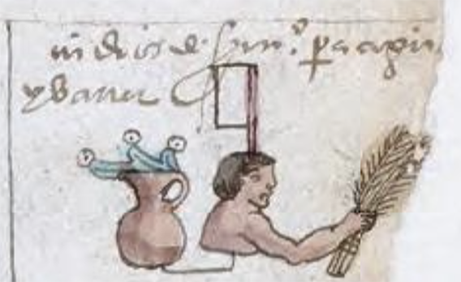
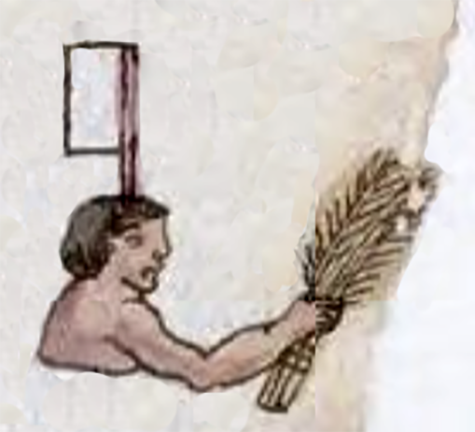
This painted simplex Nahuatl hieroglyph features a man holding a broom. He was one of a group of twenty (what would be a tecpantli, in Nahuatl) Indigenous men drafted for service to the Spanish overlord (indios de servicio, in Spanish)–indicated by the white flag (pantli or tecpantli, twenty) with a red post. These men were expected to sweep (tlachpana) and fetch water. The latter is shown in the contextualizing image by way of a pottery jug with three little hieroglyphic streams of water coming out of the top.
Stephanie Wood
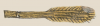
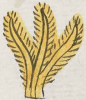
The broom (what would be called a tlachpanoni) appears to be made of a cluster of zacatl.
Stephanie Wood

barrer
Stephanie Wood
1551–1565
Jeff Haskett-Wood
escoba, limpiar, limpieza, servicio, tributo, tributos, colonialismo, protesta, protestas, resistencia
em>tlachpana, to sweep, https://nahuatl.wired-humanities.org/content/tlachpana
zaca(tl), grass, hay, straw, https://nahuatl.wired-humanities.org/content/zacatl
tecpan(tli), twenty, https://nahuatl.wired-humanities.org/content/twenty
barrer
Stephanie Wood
Library of Congress Online Catalog and the World Digital Library, Osuna Codex, or Painting of the Governor, Mayors, and Rulers of Mexico, https://www.loc.gov/resource/gdcwdl.wdl_07324/. The original is located in the Biblioteca Nacional de España.
"The Library of Congress is unaware of any copyright or other restrictions in the World Digital Library Collection. Absent any such restrictions, these materials are free to use and reuse." But please cite the Biblioteca Nacional de España and this Visual Lexicon of Aztec Hieroglyphs if you use any of these images here or refer to the content on this page, providing the URL.