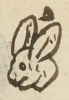
Tochtli (ATno6)
This black-line drawing of the simplex Nahuatl hieroglyph of the rabbit year sign (Tochtli) appears in association with the European calendar year 1526 as "8 Tochtli xihuitl." Each rabbit on this page is somewhat unique. This one, shown in profile and facing the viewer's right, has its ears back and is front legs straight and angling forward. It has a large round stomach. Its eye is open. Hatching appears all around the edges of the rabbit, perhaps to give it a three-dimensional effect.
Stephanie Wood
The rabbit had the dual role as a day sign and a year sign. The four year signs were house (calli), rabbit (tochtli), reed (acatl), and flint-knife (tecpatl). There were twenty day names, and their companion numbers, which rotated, ran from 1 to 13. The first year recorded in this alphabetic Nahuatl annals manuscript is 1519, the year of the Spanish landing in what would become Veracruz. The use of hieroglyphs for year signs in these annals continued for a very long time alongside the use of the Roman alphabet by Nahua tlacuilos.
Stephanie Wood
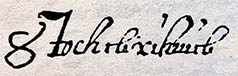
8 Tochtli xihuitli
8 Tochtli xihuitl
Stephanie Wood
c. 1720, at the latest
Stephanie Wood
fecha, nombre de año, años, conejos, calendario, calendarios, anales
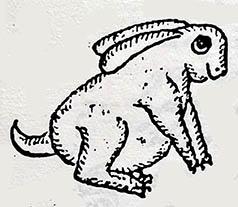
toch(tli), rabbit, https://nahuatl.wired-humanities.org/content/tochtli
el conejo
Stephanie Wood
Anales de Tlaxcala, 1519–1720. Photocopy of first page that was provided to Frances Krug by the Archivo Histórico del Instituto Nacional de Antropología e Historia. Currently in the Krug collection. Harvested by SW.
Creative Commons. Permission to publish here was given by BNAH Director Baltazar Brito.