Tochtli (Verg34r)
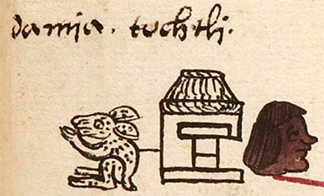
This simplex Nahuatl hieroglyph is a black-line drawing of the personal name Tochtli (“Rabbit”), attested here as a man’s name. It shows a spotted rabbit in profile facing left. It sits on its haunches. Its forearms are raised up by its mouth. Another very similar rendition of this simplex hieroglyph–also for a Damian Tochtli–appears on folio 35 verso.
Stephanie Wood
Tochtli is a common name that comes from the 260-day religious divinatory calendar, the tonalpohualli. Originally, a name such as this would have a companion number (1-13) from the calendar. The tlacuilo here may have dropped the number as a disguise, recognizing that the colonial clergy were trying to discourage the use of the ancient calendar for naming children. Serious events in Tetzcoco in 1539 may have made Nahua tlacuilos more cautious when writing and painting about aspects of their faith. See Patricia Lopes Don for information about the Inquisition case against don Carlos Ometochtli, a Chichimecatecuhtli (or Chichimecateuctli) executed in late 1539, in Bonfires of Culture, 2010. Bradley Benton (The Lords of Tetzcoco, 2017, 46) also writes that the case “demonstrates that blatant disregard for Christianity had serious consequences.” A couple of examples of the name with the companion number appear below.
The tonalpohualli, being used for "prognostication and divination, had no parallel and contravened Christian dogma so its use was disavowed and prohibited." [See Rubén G. Mendoza, Ritual Human Sacrifice in Mesoamerica (2024), 439.] Nevertheless, calendrics were an important part of Nahuas' religious views of the cosmos, and this practice survived a long time under colonialism, even if in modified form.
Stephanie Wood

damia. tochtli.
Damián Tochtli
Stephanie Wood
1539
Jeff Haskett-Wood
calendario, calendario, nombres de hombres, men’s names, conejos, nombres de días
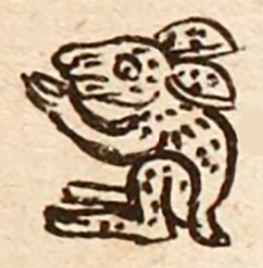
toch(tli), rabbit, https://nahuatl.wired-humanities.org/content/tochtli
Conejo
Stephanie Wood
Available at Codex Vergara, folio 34r, https://gallica.bnf.fr/ark:/12148/btv1b84528032/f75.item.zoom, accessed 1 March 2026. The Vergara is associated with Tepetlaoztoc, in the larger region of Tetzcoco, c. 1539–1543. “Source gallica.bnf.fr / BnF.” We would also appreciate a citation to the Visual Lexicon of Aztec Hieroglyphs, https://aztecglyphs.wired-humanities.org/.
Image Rights: The non-commercial reuse of images from the Bibliothèque nationale de France is free as long as the user is in compliance with the legislation in force and provides the citation: “Source gallica.bnf.fr / Bibliothèque nationale de France” or “Source gallica.bnf.fr / BnF.” We would also appreciate a citation to the Visual Lexicon of Aztec Hieroglyphs, https://aztecglyphs.wired-humanities.org/