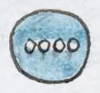
tomin (Chav1)
This is a red drawing of the simplex glyph for the noun tomin (coin, or money). It is a circle with what seems to be a numeral four in the center, indicating that this sign represents four tomines.
Stephanie Wood
The way the digit 4 is tipped over here, suggests that the Nahua tlacuilo might not have realized that it was a number, although he surely knew it meant four tomines (the value of half a peso). See another example of a hieroglyph representing four tomines from the Codex Osuna, below. In that case, the four is upright and more like the European digit. Another tomin glyph, that one representing three tomines, appears next to the one
Tlacuilos sometimes wrote tomin alphabetically and, sometimes when speaking of a plural number of reales, they wrote tomines (the Spanish plural and a loanword), as can be found in our Online Nahuatl Dictionary entry for tomin. Over time, tomin could increasingly refer more generally to "money."
Stephanie Wood
1578
Jeff Haskett-Wood

tomin, a coin, one eight of a peso, a real, also money, https://nahuatl.wired-humanities.org/content/tomin
The Codex Chavero of Huexotzinco (or Códice Chavero de Huexotzinco), https://www.loc.gov/resource/gdcwdl.wdl_03246_001/?sp=1
The Codex Chavero of Huexotzinco (or Códice Chavero de Huexotzinco) is held by the Instituto Nacional de Antropología e Historia, México. It is published online by the World Digital Library and the Library of Congress, which is “unaware of any copyright or other restrictions in the World Digital Library Collection.”