totolin (LTlaxUT1b)
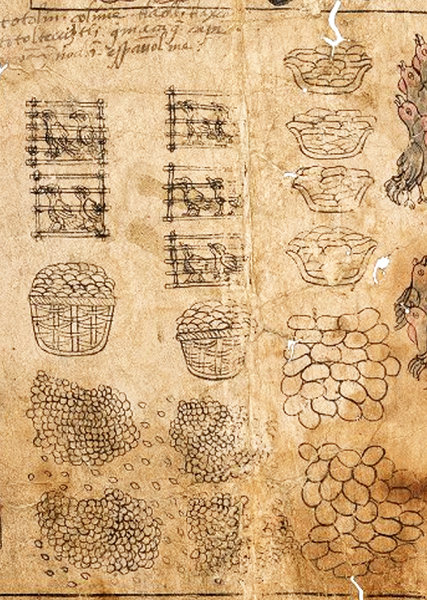
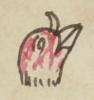
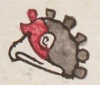
This painted simplex Nahuatl hieroglyph is a painting of a group of about 18 turkeys that were part of the tribute provided by the Tlaxcalteca to their Spanish allies on the march toward Tenochtitlan. This is just one of three groups of turkeys in the total tribute provisions in the contextualizing image. These birds appear to be alive, as their eyes are open. But, they are not in cages or tied up, just grouped. Twenty would have been a more likely number per group, given the vigesimal (base 20) numbering system. The turkeys’ heads are pointing upwards. The feathers on the heads are red, and their bodies have dark gray feathers.
Stephanie Wood
In The Aztecs (2005, 114), Dirk R. Van Tuerenhout reports that turkeys were the only domesticated fowl in pre-contact Mesoamerica. Other birds were eaten, but turkeys were raised for this purpose. Eight thousand turkeys sold every five days in the market at Tepeyac, a testament to their popularity. Incidentally, 8,000 (xiquipilli) is also a vigesimal number. See other examples of turkeys below.
Stephanie Wood
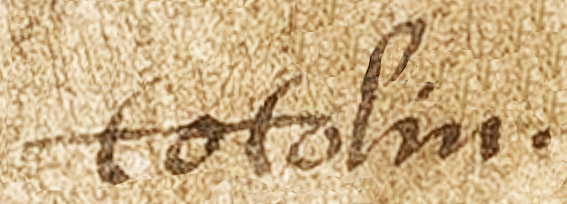
totolin.
totolin
Stephanie Wood
1540s
Jeff Haskett-Wood
pavo, pavos, guajolote, guajolotes, comida, tributo, tributos, aliados, españoles
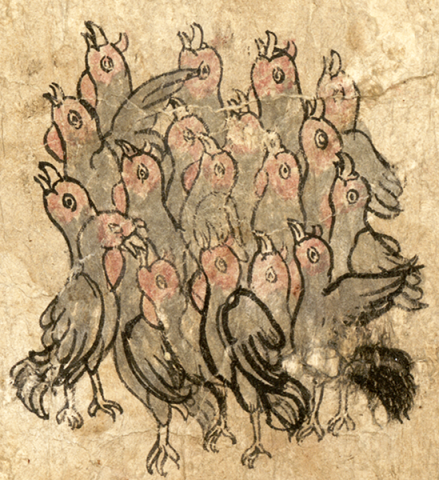
totol(in), domestic wild turkeys, https://nahuatl.wired-humanities.org/content/totolin
pavo o guajolote
Stephanie Wood
Benson Latin American Collection, LLILAS Benson Latin American Studies and Collections, The University of Texas at Austin https://collections.lib.utexas.edu/catalog/utblac:3c754fd0-b27f-4af7-9cf...
The Benson Library has kindly provided the digital images and permission to put them into our Mapas Project in 2015. Use and reproduction from this project: https://creativecommons.org/publicdomain/mark/1.0/, but please also cite the Visual Lexicon of Aztec Hieroglyphs, ed. Stephanie Wood, (Eugene, Ore.: Wired Humanities Projects, ©2020-present). Version 1.0.