Xolohua (Verg49r)
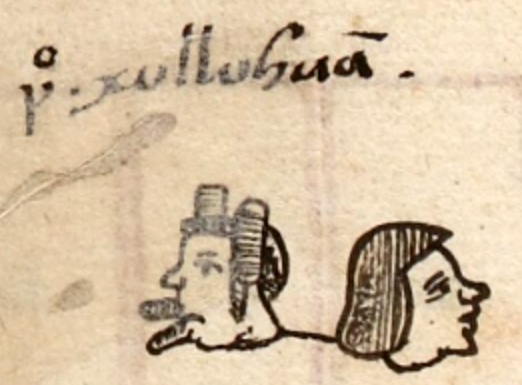
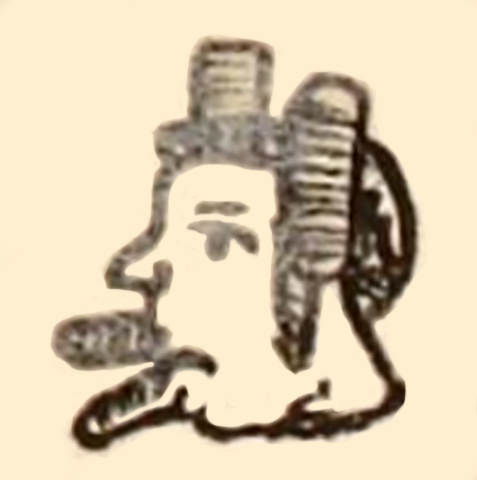
This simplex Nahuatl hieroglyph is a black-line drawing of the personal name Xolohua (“Possessor of Xolotl” or “Slaveholder”), attested here as a man’s name. Xolotl is represented as the head of a man in profile, facing left. But this man has large, squared off, striped, ear-like protrusions that reach above his head, one on each side. Perhaps these are meant to replicate dogs’ ears. Two striped protrusions also come from the mouth. These are somewhat narrower and less rectangular at the ends. It is unclear how these contribute to the reading of Xolotl in this hieroglyph.
Stephanie Wood
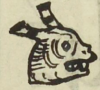
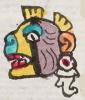
Representations of Xolotl can often have characteristics of a dog, with protruding teeth. The wrinkles in its face may recall the aged, ancestor role of the Chichimec leader named Xolotl. The xoloitzcuintli also has wrinkles on its face, but its ears are not squared off like this. This dog’s squared-off ears are reminiscent of some representations of nenetl in the form of the doll or divine force figurine. Xolotl ears can have stripes on them. The Codex Mendoza images of Xolotl show multiple colors and vertical face paint or tattoos in black stripes. If this is not about the ancestral, divine, or canine representation of Xolotl, perhaps it refers to a servant or an enslaved person (as Molina suggests).
Stephanie Wood
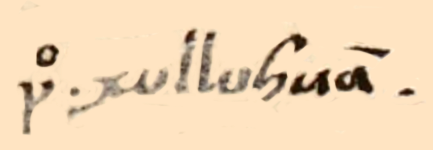
po. xollohuā.
Pedro Xolohua
Stephanie Wood
1539
Jeff Haskett-Wood
fuerzas divinas, ancestros, Chichimecas, perro, perros, posesión,nombres de hombres, nombres de deidades
Xolotl, personal name, ancestor, divine force, and dog, https://nahuatl.wired-humanities.org/content/Xolotl
-hua, singular possessive suffix, https://nahuatl.wired-humanities.org/content/hua
posiblemente, Poseedor de Xolotl
Stephanie Wood
Available at Codex Vergara, folio 49r, https://gallica.bnf.fr/ark:/12148/btv1b84528032/f105.item.zoom, accessed 25 March 2026. The Vergara is associated with Tepetlaoztoc, in the larger region of Tetzcoco, c. 1539–1543. “Source gallica.bnf.fr / BnF.” We would also appreciate a citation to the Visual Lexicon of Aztec Hieroglyphs, https://aztecglyphs.wired-humanities.org/.
Image Rights: The non-commercial reuse of images from the Bibliothèque nationale de France is free as long as the user is in compliance with the legislation in force and provides the citation: “Source gallica.bnf.fr / Bibliothèque nationale de France” or “Source gallica.bnf.fr / BnF.” We would also appreciate a citation to the Visual Lexicon of Aztec Hieroglyphs, https://aztecglyphs.wired-humanities.org/