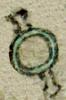
yaotlatquitl (FCbk12f11r)
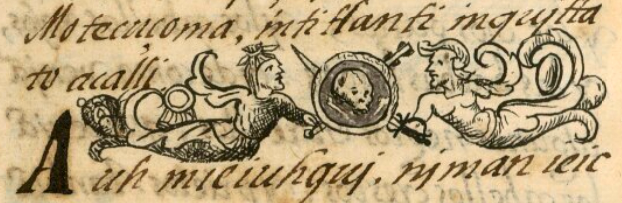
This is an iconographic example that features a black and white sketch of a decorative element in the Nahuatl text, one symbolic of the Nahua-Spanish conflict that was expected in memories of 1519 and featuring the sword and macuahuitl, weapons of both sides (yaotlatquitl). It is a heavily Europeanized medieval graphic. It is included in this digital collection for the purpose of making comparisons with related hieroglyphs. The term selected for this example comes from the text near the image in the Digital Florentine Codex. There is no gloss, per se. This example shows three-quarter views of a Mexica warrior on the left and a Spaniard on the right. Between them is a war shield and, crossed behind the shield, are an iron sword (called, at that time, a tepoztli) and an obsidian-blade embedded club (macuahuitl), or what came to be called a macana in Spanish. The shield is decorated with a skull and two crossbones, symbolizing death. The Mexica has a wrapped clump of hair standing up on his head (what is often called a tzontli). The Spaniard has a stylized helmut of armor on his head. Each of these opponents has one arm that is more like a fin, but the other arm ends in something like a hand that grasps the end of his corresponding weapon. Curling elements appear to give them tails, like mermen can have. The bare chest on the Spaniard supports the idea of a merman, too. Inside each of these curls are small shields, one for each figure and seemingly corresponding to shields each might have carried into war. The Mexica figure has some additional, indistinguishable, dark shape near or as a part of his tail.
Stephanie Wood
A study by Kendra Brown, “Examining merfolk symbolism in manuscript borders from 1400 C.E. to 1550 C.E.,” published on line in TOTA has various mermen that have some of the features of these mythical figures, including some that are armed and in a face-off stance. The use of mermen must have stemmed from the growing familiarity among the tlacuilos with medieval or Renaissance illuminated manuscripts coming from Europe. In this case, the image seems to have been inspired by the text that refers to yaotlatquitl (war gear), and so that is our focus here. Hieroglyphs of yaoyotl (war) and yaotl (combatant) feature regularly in this collection, as do weapons, including the pairing of a shield and a macuahuitl as a well-known symbol of war. That, possibly too, contributed to the creation of this flourish in the text. Finally, note how the noun is possessed in the text, “their war gear,” which appears below.
Regarding the skull and crossbones, one set of annals from Puebla, Tepeaca, Cholula (1524–1645) includes an image of three skulls and crossbones where it refers to the burning of corpses in the wake of an epidemic in Huexotzinco. [Noted in: Frances Krug, "The Nahuatl Annals of the Tlaxcala-Puebla Region," ch. 3, p. 85, Ph.D. Dissertation draft written in the 1980s, with transcriptions and translations approved by James Lockhart.]
Stephanie Wood
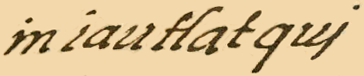
iniautlatqui
inyaotlatquitl
Stephanie Wood
1577
Jeff Haskett-Wood
espada, espadas, macuahuitl, macana, macanas, conflicto, batallas, conquista, conquistas, guerra
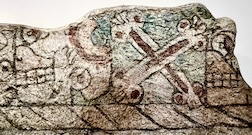
While a skull and crossbones might suggest European influence, this imagery also existed in pre-contact times, as the frescos and bas relief sculptures of the archaeological zone at Tenayuca attest. (Witnessed by SW, 3 February 2026.)
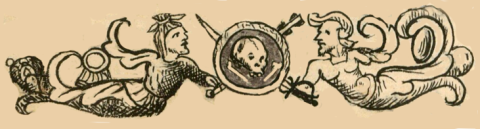
yaotlatqui(tl), war gear, weapons, https://nahuatl.wired-humanities.org/content/yaotlatquitl
armas, equipo de guerra
Stephanie Wood
Available at Digital Florentine Codex/Códice Florentino Digital, edited by Kim N. Richter and Alicia Maria Houtrouw, "Book 12: Conquest of Mexico", fol. 11r, Getty Research Institute, 2023. https://florentinecodex.getty.edu/en/book/12/folio/11r/images/0 Accessed 7 February 2026.
Images of the digitized Florentine Codex are made available under the following Creative Commons license: CC BY-NC-ND (Attribution-NonCommercial-NoDerivs 4.0 International). For print-publication quality photos, please contact the Biblioteca Medicea Laurenziana ([email protected]). The Library of Congress has also published this manuscript, using the images of the World Digital Library copy. “The Library of Congress is unaware of any copyright or other restrictions in the World Digital Library Collection. Absent any such restrictions, these materials are free to use and reuse.”