teoxalli (FCbk11f215v)
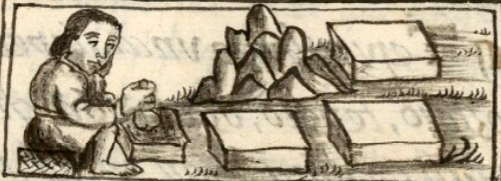
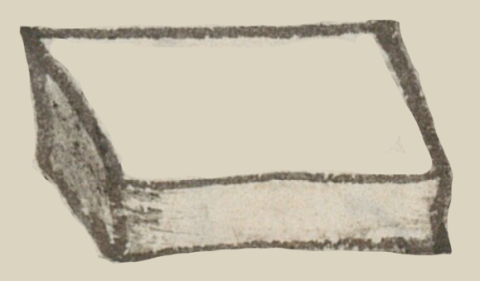
This iconographic example, featuring the emery grinding stone (teoxalli), is included in this digital collection for the purpose of making comparisons with related hieroglyphs. The term selected for this example comes from the text near the image in the Digital Florentine Codex. There is no gloss, per se. This example shows a flat, cut, rectangular stone. The text says it could be red, blue, or brown, and that it could be ground down into sand that was used to polish other precious stones. The “preciousness” of those stones may be reflected in the “teo-” (from teotl, divinity or deity) start to the name for the sand (xalli). The stone shown here has some shading that gives it a three-dimensionality, revealing European artistic influence. This is also true of the perspective and the landscape setting where the teoxalli stone appears. In the contextualizing image, one can see the background features a mountain, possibly the source of the stones. Also, a man pounds one of the stones in the group that can be seen in the foreground on the left. He is shown in profile, but he wears a Spanish-style tunic and his hair is longer than was typically worn by a macehualli, but he is still a Nahua
Stephanie Wood
This is the first example of teoxalli to enter this digital collection (as of December 2025), but sand (xalli) and various type of sand are relatively prevalent.
Stephanie Wood

Teuxalli
teoxalli
Stephanie Wood
1577
Jeff Haskett-Wood
arena, pulir, piedra, piedras, lijar, limpiar
teoxal(li), a grinding stone, https://nahuatl.wired-humanities.org/content/teoxalli
el esmeril
Stephanie Wood
Available at Digital Florentine Codex/Códice Florentino Digital, edited by Kim N. Richter and Alicia Maria Houtrouw, "Book 11: Earthly Things", fol. 215v, Getty Research Institute, 2023. https://florentinecodex.getty.edu/en/book/11/folio/215v/images/0 Accessed 16 November 2025.
Images of the digitized Florentine Codex are made available under the following Creative Commons license: CC BY-NC-ND (Attribution-NonCommercial-NoDerivs 4.0 International). For print-publication quality photos, please contact the Biblioteca Medicea Laurenziana ([email protected]). The Library of Congress has also published this manuscript, using the images of the World Digital Library copy. “The Library of Congress is unaware of any copyright or other restrictions in the World Digital Library Collection. Absent any such restrictions, these materials are free to use and reuse.”