tlapehualli (FCbk11f243v)
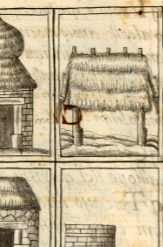
This iconographic example, featuring a black and white sketch of thatch canopy (tlapehualli) that is called a portal in the Spanish, is included in this digital collection for the purpose of making comparisons with related hieroglyphs. The term selected for this example comes from the text near the image in the Digital Florentine Codex. There is no gloss, per se. This example shows a free standing roof-like feature atop two wide trunk-like posts. This roof is thatched with three horizontal rows of grasses. Five small posts protrude above the top of the thatch. The tlapehualli stands on uneven ground, a landscape feature that was learned from colonial art instructors along with the shading that provides three-dimensionality.
Stephanie Wood
A similar canopy in this collection comes from the Codice Sierra-Texupan. That one relates to the nativity festivities at Christmas in a Mixtec town in what is now the state of Oaxaca.
Stephanie Wood
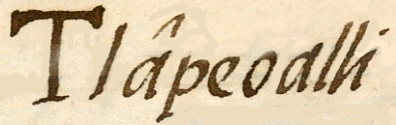
Tlapeoalli
tlapehualli
Stephanie Wood
1577
Jeff Haskett-Wood
portales, techos, zacate, grasses, thatch, wood, postes de madera
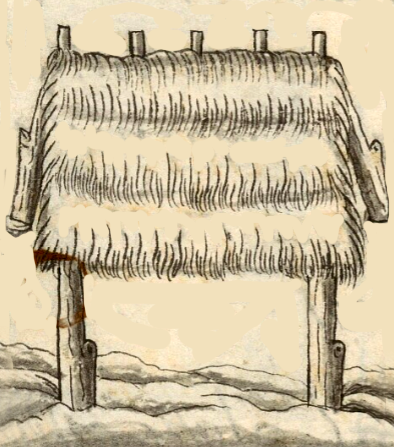
tlapehual(li), a canopy or portal, https://nahuatl.wired-humanities.org/content/tlapehualli
un portal con el techo de paja
Stephanie Wood
Available at Digital Florentine Codex/Códice Florentino Digital, edited by Kim N. Richter and Alicia Maria Houtrouw, "Book 11: Earthly Things", fol. 243v, Getty Research Institute, 2023. https://florentinecodex.getty.edu/en/book/11/folio/243v/images/0 Accessed 16 November 2025.
Images of the digitized Florentine Codex are made available under the following Creative Commons license: CC BY-NC-ND (Attribution-NonCommercial-NoDerivs 4.0 International). For print-publication quality photos, please contact the Biblioteca Medicea Laurenziana ([email protected]). The Library of Congress has also published this manuscript, using the images of the World Digital Library copy. “The Library of Congress is unaware of any copyright or other restrictions in the World Digital Library Collection. Absent any such restrictions, these materials are free to use and reuse.”