Ahuililama (Verg23v)
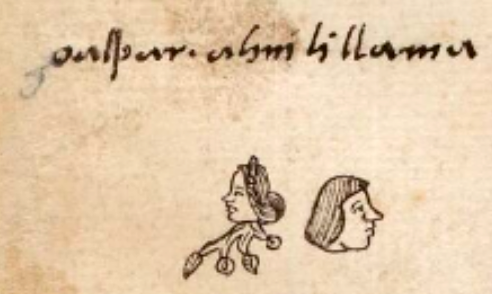
This compound Nahuatl hieroglyph is a black-line drawing of the personal name Ahuililama, attested here as a man’s name. It is a man’s name, but it refers to an “elder woman” (ilama) who enjoys sex. The woman’s head is in profile, facing left. She has the traditional hairstyle for a married or adult woman, the neaxtlahualli or axtlahuilli. Water (atl) flows below this head, seemingly providing the “A-” start to the name. There is nothing particularly aged about this woman. It is interesting how a man might have the name of an elder woman, especially one who was possibly considered illicit.
Stephanie Wood
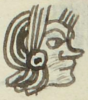
Another compound hieroglyph for the name Ahuililama appears on folio 25 verso. That one has age lines on the cheek of the woman, while this one does not.
Stephanie Wood
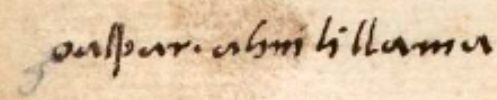
gaspar.ahuilillama
Gaspar Ahuililama
Stephanie Wood
1539
Jeff Haskett-Wood
mujer, mujeres, vieja, viejas, fonetismo, nombres de hombres, men’s names
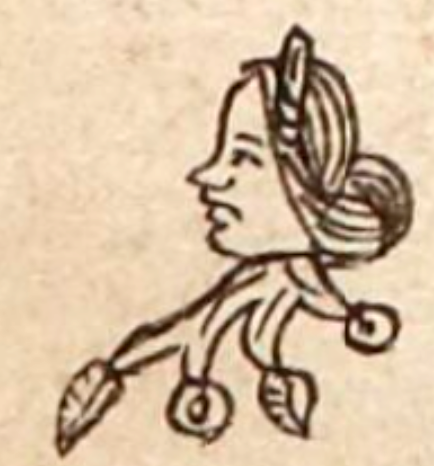
ahuililama, an old sex-loving woman, https://nahuatl.wired-humanities.org/content/cihuatl
ilama, an elder woman, https://nahuatl.wired-humanities.org/content/ilama
ahuil(li), play or frivolity, https://nahuatl.wired-humanities.org/content/ahuilli
Available at Codex Vergara, folio 23v https://gallica.bnf.fr/ark:/12148/btv1b84528032/f54.item.zoom, accessed 22 February 2026. The Vergara is associated with Tepetlaoztoc, in the larger region of Tetzcoco, c. 1539–1543.
The non-commercial reuse of images from the Bibliothèque nationale de France is free as long as the user is in compliance with the legislation in force and provides the citation: “Source gallica.bnf.fr / Bibliothèque nationale de France” or “Source gallica.bnf.fr / BnF.” We would also appreciate a citation to the Visual Lexicon of Aztec Hieroglyphs, https://aztecglyphs.wired-humanities.org/.