ayoxochitl (FCbk8f50r)
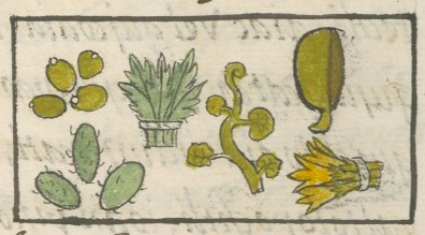
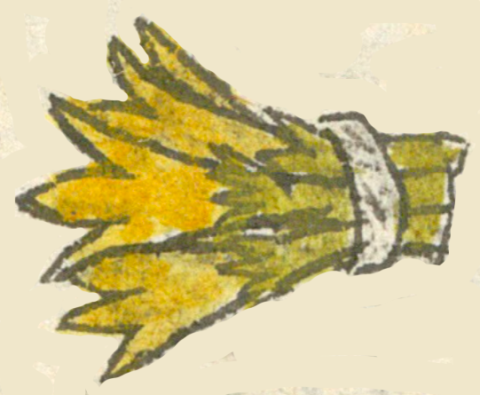
This iconographic example, featuring squash blossoms (ayoxochitl), is included in this digital collection for the purpose of making potential comparisons with related hieroglyphs. The term selected for this example comes partly from the keywords (ayotli, or ayohtli with the glottal stop) chosen by the team behind the Digital Florentine Codex, partly from the visual itself, and partly from our own Online Nahuatl Dictionary. There is no direct reference in the Nahuatl text to this flower on this particular manuscript page (Book 8, f. 50r). This example shows a group of squash blossoms in profile. The flowers are yellow, and the stems are green. Each flower has three spiky petals. The bundle is tied (as in tlalpilli, something tied) with a white band that has some black mottling. In the codex, the context makes it clear that this is one of several edible greens for sale in the marketplace.
Stephanie Wood
Esta imagen iconográfica, que muestra unas flores de calabaza (ayoxochitl), se incorpora a esta colección digital con el objetivo de servir como posible punto de comparación con jeroglíficos afines. El término asignado a este ejemplar proviene, en parte, de las palabras clave (ayotli, o ayohtli, si se escribe como oclusiva glotal) seleccionadas por el equipo del Códice Florentino Digital. Para su selección se retomaron, por un lado, la imagen correspondiente y, por otro, nuestro propio diccionario digital del náhuatl (Online Nahuatl Dictionary). No hay una referencia directa a la flor en el texto en náhuatl en esta página específica del manuscrito (libro 8, f.50r). La imagen muestra un manojo de flores de calabaza representado de perfil. Las flores son amarillas y los tallos, verdes. Cada flor tiene tres pétalos puntiagudos. El manojo aparece atado (como en tlalpilli, cosa atada) con una banda blanca con motas negras. En el códice, por el contexto se entiende que este es uno de los numerosos quelites que se vendían en el mercado.
Squash blossoms, which are still so prevalent in Mexican cuisine, are nevertheless somewhat rare in this digital collection.
Stephanie Wood
No obstante, las flores de calabaza, que aún se emplean con frecuencia en la cocina mexicana, son escasas en esta colección digital.
1577
Jeff Haskett-Wood
flores, calabazas, comida, verduras, mercado, mercados, plantas
ayoxoch(itl), squash blossom(s), https://nahuatl.wired-humanities.org/content/ayoxochitl
tlalpil(li), something tied, https://nahuatl.wired-humanities.org/content/tlalpilli
la flor de calabaza
Stephanie Wood
Available at Digital Florentine Codex/Códice Florentino Digital, edited by Kim N. Richter and Alicia Maria Houtrouw, "Book 8: Kings and Lords", fol. 50r, Getty Research Institute, 2023. https://florentinecodex.getty.edu/en/book/8/folio/50r/images/0 Accessed 25 August 2025.
Images of the digitized Florentine Codex are made available under the following Creative Commons license: CC BY-NC-ND (Attribution-NonCommercial-NoDerivs 4.0 International). For print-publication quality photos, please contact the Biblioteca Medicea Laurenziana ([email protected]). The Library of Congress has also published this manuscript, using the images of the World Digital Library copy. “The Library of Congress is unaware of any copyright or other restrictions in the World Digital Library Collection. Absent any such restrictions, these materials are free to use and reuse.”