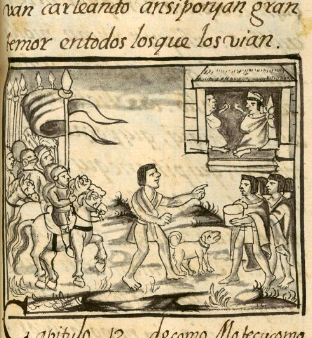
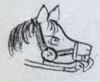
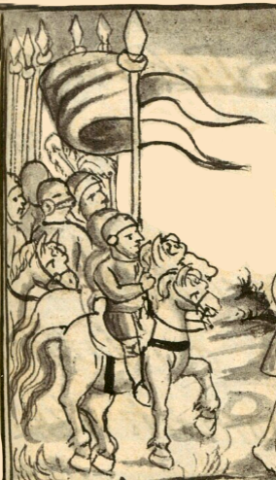
caballo (FCbk12fir)
This iconographic example features a black and white sketch of three horses (each one often referred to as a caballo or a cahuayo, using or modifying the word from Spanish, when not, at very first being, referred to as deer/mazatl). These horses are included in this digital collection for the purpose of making comparisons with related hieroglyphs. There is no gloss, per se, and no related text nearby. This example shows three horses that probably recently came off one or more Spanish ships in the harbor at the gulf at the time of the invasion (as it was remembered later). The horses have saddles and bridles. The two on the right are in profile view, while the one on the left is shown in a ¾ view. The one on the left has a front leg raised as though it is in motion. They all have shading in the form of cross-hatching, a learned European artistic style. The landscape setting is also rooted in those foreign influences. Nahuas typically drew horses in some detail, apparently very interested in them, given that they were new. Nahuas would eventually petition the viceregal government in the sixteenth century for permission to ride horses.
Stephanie Wood
Hieroglyphs of horses include (at this point, February 2026), both the whole animals or just the head. Another iconographic example comes from the Codex Azcatitlan, page 29.
Stephanie Wood
1577
Jeff Haskett-Wood
caballos, brida, silla de montar, bridas, sillas
caballo, a horse, https://nahuatl.wired-humanities.org/content/caballo
el caballo
Stephanie Wood
Available at Digital Florentine Codex/Códice Florentino Digital, edited by Kim N. Richter and Alicia Maria Houtrouw, "Book 12: Conquest of Mexico", fol. ir, Getty Research Institute, 2023. https://florentinecodex.getty.edu/en/book/11/folio/ir/images/0 Accessed 7 February 2026.
Images of the digitized Florentine Codex are made available under the following Creative Commons license: CC BY-NC-ND (Attribution-NonCommercial-NoDerivs 4.0 International). For print-publication quality photos, please contact the Biblioteca Medicea Laurenziana ([email protected]). The Library of Congress has also published this manuscript, using the images of the World Digital Library copy. “The Library of Congress is unaware of any copyright or other restrictions in the World Digital Library Collection. Absent any such restrictions, these materials are free to use and reuse.”