cacahuatl cuechtic (TK222v)
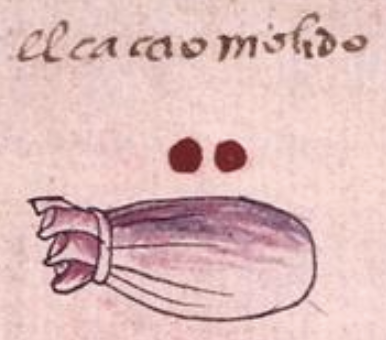
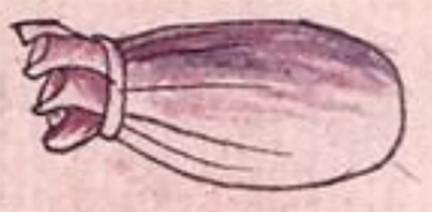
This painted simplex Nahuatl hieroglyph represents a sack of cacao beans (cacahuatl) that has been finely ground (cuechtic). The gloss says “el cacao molido,” and we have chosen the Nahuatl terms for the translation from our Online Nahuatl Dictionary, hoping that they will suffice. The glyph is a white (probably cotton) sack lying flat and tied on one end. Shading gives it three-dimensionality, an artistic style introduced by European teachers. There is no indication of the contents of the bag aside from the gloss, but other pages in this manuscript mention cacao as a tribute item regularly.
Stephanie Wood
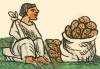
Ground cacao was–and still is–the basis for a delicious hot drink that was originally reserved for the Indigenous elite. Most hieroglyphs that include cacao show the cacao bean in some way. The reason no bean is shown here may be because the contents of the sack was ground, not whole.
Stephanie Wood

el cacao molido
Stephanie Wood
c. 1556
Jeff Haskett-Wood
chocolate, cocoa, bebida, bebidas, bolsa, carga, granos, tributo, tributos, resistencia, colonialismo
cacahua(tl), cacao, https://nahuatl.wired-humanities.org/content/cacahuatl
cuechtic, finely ground, https://nahuatl.wired-humanities.org/content/cuechtic
el cacao molido
Stephanie Wood
The Codex Kingsborough, also known as the Códice de Tepetlaoztoc, and the Memorial de los indios de Tepetlaoztoc, is not on display. It was transferred from the British Library and is now held by the British Museum. It is shared on line at: https://www.britishmuseum.org/collection/object/E_Am2006-Drg-13964
©The Trustees of the British Museum. Shared under a Creative Commons Attribution-Non-Commercial-ShareAlike 4.0 International (CC BY-NC-SA 4.0) license. Please also cite the <em>Visual Lexicon of Aztec Hieroglyphsem>, ed. Stephanie Wood (Eugene, Ore.: Wired Humanities Projects, 2020-present) and this URL.