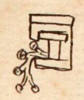
Calli (MH896r)
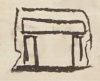
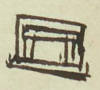
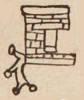
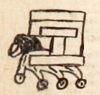
This black-line drawing of the simplex glyph for the personal name Calli (“House”) is attested here as a man’s name. The glyph shows a house or building in profile, facing right. Interestingly, the roof has a stepped design of the sort that dates back to Classic Period architecture, such as that seen at Teotihuacan. This man's first name Tolipio (for Toribio) apparently honors the member of the famous group of the first twelve friars to arrive in Mexico. Toribio de Benavente Motolinia was still alive at the time that this manuscript was prepared. He apparently found favor among the Nahuas, and late in life he did spend a fair amount of time in the area of Puebla and Tlaxcala, so not terribly far from Huexotzinco
Stephanie Wood
This is a calendrical name, most likely taken from the religious divinatory calendar, the tonalpohualli, which was often a source for individuals' personal names. Calli is both a day sign and a year sign. Normally, the day name “House” would have had a companion number (1–13 with a day name, or 1–4 when a year bearer), but that number has dropped away inadvertently or it was suppressed in the face of the colonial clergy’s prohibition of the continuing use of the pre-contact calendars.
The tonalpohualli, being used for "prognostication and divination, had no parallel and contravened Christian dogma so its use was disavowed and prohibited." [See Rubén G. Mendoza, Ritual Human Sacrifice in Mesoamerica (2024), 439.] Nevertheless, calendrics were an important part of Nahuas' religious views of the cosmos, and this practice survived a long time under colonialism, even if in modified form.
Stephanie Wood

tolipio calli
Toribio Calli
Stephanie Wood
1560
Jeff Haskett-Wood
casas, edificios, calendarios, tonalpohualli, xiuhpohualli, nombres de años, nombres de días, nombres de hombres

cal(li), house or building, https://nahuatl.wired-humanities.org/content/calli
Casa
Stephanie Wood
Matrícula de Huexotzinco, folio 896r, World Digital Library, https://www.loc.gov/resource/gdcwdl.wdl_15282/?sp=864&st=image.
This manuscript is hosted by the Library of Congress and the World Digital Library; used here with the Creative Commons, “Attribution-NonCommercial-ShareAlike 3.0 License” (CC-BY-NC-SAq 3.0).