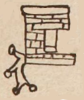
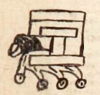
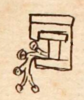
Calli (MH493r)
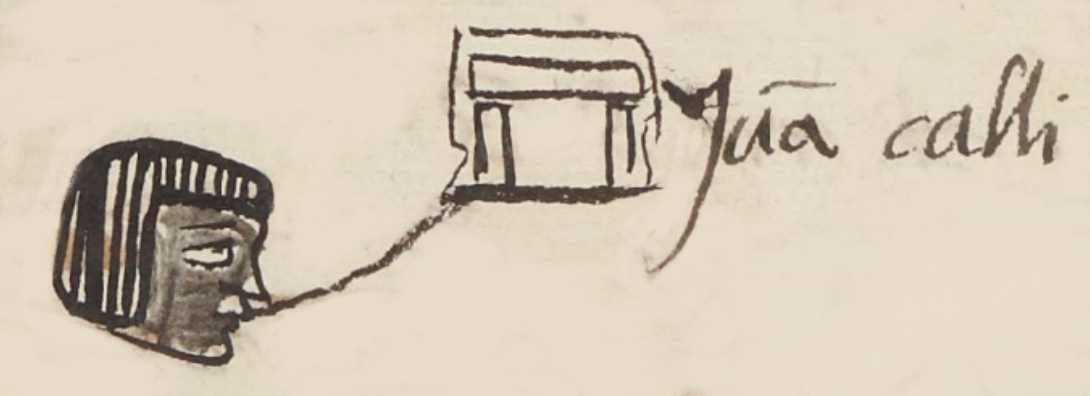
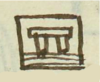
This black-line drawing of a simplex glyph for a house or building (calli) is also the Nahua name of a baptized man, Juan Calli. The glyph has a somewhat rare, full frontal view of a building. It features a large entry way lined with broad wooden beams.
Stephanie Wood
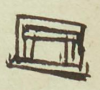
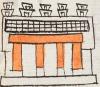
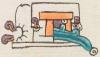
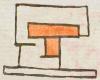
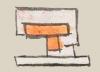
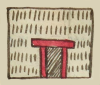
The calli is both a day sign in the tonalpohualli and a year sign in the xiuhpohualli. As a personal name, it is more likely to come from the religious divinatory calendar (tonalpohualli). Probably, here, it was a day sign that once had a numeral to go with it, indicating on which calli day the person was born. Dropping the use of such a number could represent a fading tradition or an effort to disguise the continuing use of the tonalpohualli calendar. The calli is rarely given in a frontal view. When it is a frontal view, it is because there an unusual feature or building with a specific purpose that is being emphasized. Otherwise, normally, a generic calli is shown in profile. It can face left or right. See some examples below.
The tonalpohualli, being used for "prognostication and divination, had no parallel and contravened Christian dogma so its use was disavowed and prohibited." [See Rubén G. Mendoza, Ritual Human Sacrifice in Mesoamerica (2024), 439.] Nevertheless, calendrics were an important part of Nahuas' religious views of the cosmos, and this practice survived a long time under colonialism, even if in modified form.
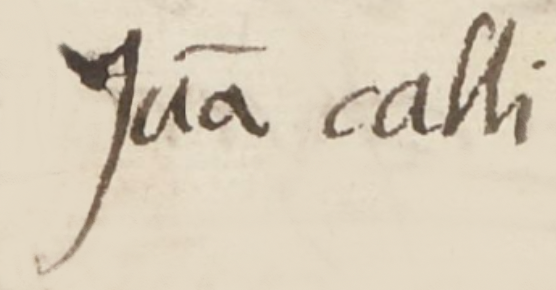
Juā calli
Juan Calli
Stephanie Wood
1560
José Aguayo-Barragán and Stephanie Wood
houses, casas, buildings, edificios, names, nombres, hombres, tonalpohualli, xiuhpohualli, turquesa, xihuitl, nombres de días, nombres de años, nombres de hombres
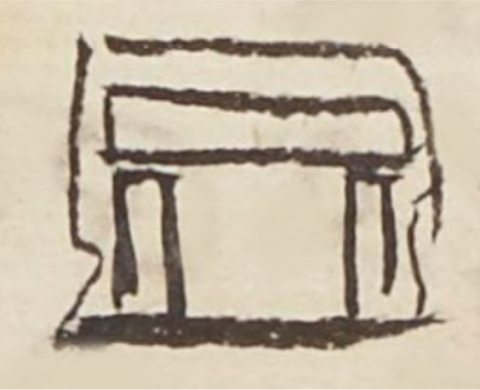
cal(li), house or building, https://nahuatl.wired-humanities.org/content/calli
Matrícula de Huexotzinco, folio 493r, World Digital Library. https://www.loc.gov/resource/gdcwdl.wdl_15282/?sp=65&st=image
This manuscript is hosted by the Library of Congress and the World Digital Library; used here with the Creative Commons, “Attribution-NonCommercial-ShareAlike 3.0 License” (CC-BY-NC-SAq 3.0).