casa (TK216r)
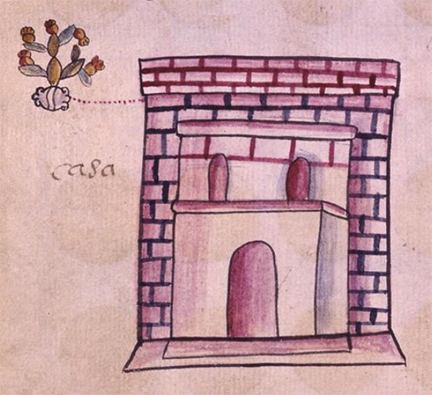
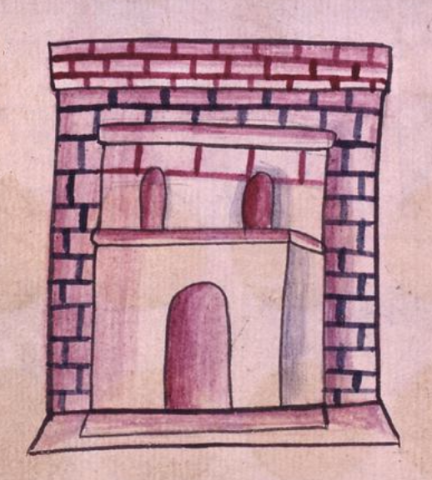
This painted simplex Nahuatl hieroglyph represents a house (glossed in Spanish “casa,” house, but this was also a loanword taken into Nahuatl). This is a house that Nahua tribute payers had to build for a mercantile agent (factor in Spanish, but this was another loanword taken into Nahuatl) in Mexico City. The companion text notes how the Nahua community of Tepetlaoztoc had to bring a huge quantity of gold pesos, plus all the supplies, the masons, and the day laborers for the construction project. The town received nothing for this investment of goods, funds, and workers. The house appears to be of adobe bricks or cut stone, it has an arched doorway and two arched windows. Shading in these openings provides a three-dimensionality, a learned European style.
Stephanie Wood
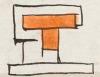
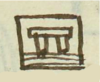
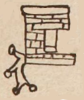
The word in Nahuatl for house is calli, and a great many hieroglyphs have a calli as an element. In the earliest manuscripts, the calli appears in profile (e.g., calli, Codex Mendoza f. 33r), but by 1560 more of them appear in a frontal view (e.g., Calchopitl, Matrícula de Huexotzinco f. 658r), such as the one built for the factor. Even then, however, a white stucco facade and a terracotta-colored wooden framing around the front entrance are typical. This house, the residence of the factor, looks more elaborate than most Nahua homes. Occasionally, in 1560, one does see a delineation of stones possibly cut into rectangular shapes or adobe bricks (e.g., calli, Codex Vergara, f. 23r, and michcalli, Ramo de Tierras, vol. 2681, exp. 6, f. 2r).
Juan José Batalla points out how a curving arched doorway, sometimes called tecololli in Nahuatl (and notes how perhaps tolcalli would be more appropriate), is a European architectural introduction. See: "Análisis de elementos gráficos de contenido occidental en los glifos de los códices coloniales del Centro de México: el caso de los antropónimos nahuas," in El arte de escribir. El Centro de México: del Posclásico al siglo XVII, eds. Juan José Batalla Rosado and Miguel Ángel Ruz Barrio (Zinacantepec, Estado de México: El Colegio Mexiquense, A. C., 2018), 84.]
Side Note: The folio numbers are not always clear in the copy published online by the British Museum. Marc Thouvenot gives this page the number K14_A in his TLACHIA digital collection, https://tlachia.iib.unam.mx/tepetlaoztoc/K14_A.
Stephanie Wood

vna casa de su morada
una casa de su morada
Stephanie Wood
c. 1556
Jeff Haskett-Wood
edificio, edificios, casas, arquitectura, trabajo, tributos, abusos, protesta, juicio
casa, house (a loanword from Spanish), https://nahuatl.wired-humanities.org/content/casa
cal(li), house, https://nahuatl.wired-humanities.org/content/calli
la casa
Stephanie Wood
The Codex Kingsborough, also known as the Códice de Tepetlaoztoc, and the Memorial de los indios de Tepetlaoztoc, is not on display. It was transferred from the British Library and is now held by the British Museum. It is shared on line at: https://www.britishmuseum.org/collection/object/E_Am2006-Drg-13964
©The Trustees of the British Museum. Shared under a Creative Commons Attribution-Non-Commercial-ShareAlike 4.0 International (CC BY-NC-SA 4.0) license. Please also cite the <em>Visual Lexicon of Aztec Hieroglyphsem>, ed. Stephanie Wood (Eugene, Ore.: Wired Humanities Projects, 2020-present) and this URL.