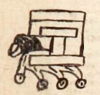
Calli (Verg23r)
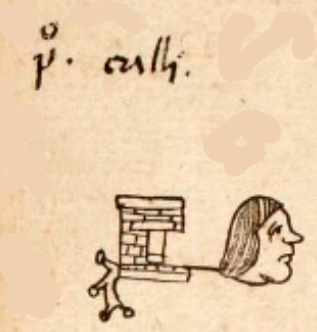
This compound Nahuatl hieroglyph is a black-line drawing of the personal name Calli (“House” or “Building”), attested here as a man’s name. It has two elements. The most crucial is the sign for house in profile, with the opening facing right. Interestingly, this calli seems constructed of adobe (xamitl) bricks or possibly rectangular stones. The other element, water (atl), is a phonetic complement that is intended to emphasize that the first vowel sound in this name is an “a.” the phonetic syllable is not a requisite element. Unusually, the water springs out of the back of the building, not its entryway. The water has four droplets splashing off the little stream, but no lines of current.
Stephanie Wood
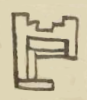
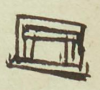
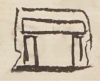
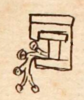
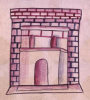
The Matrícula de Huexotzinco includes several examples of Nahuatl hieroglyphs for the personal name Calli. One of these has the calli in profile, and the other two have frontal views. None of these adds another element, such as atl. This name, not having a numerical component to go with the day sign, may represent an effort to disguise that this was a tonalpohualli name. Serious events in Tetzcoco in 1539 may have made Nahua tlacuilos more cautious when writing and painting about aspects of their faith. See Patricia Lopes Don for information about the Inquisition case against don Carlos Ometochtli, a Chichimecatecuhtli (or Chichimecateuctli) executed in late 1539, in Bonfires of Culture, 2010. Bradley Benton (The Lords of Tetzcoco, 2017, 46) also writes that the case “demonstrates that blatant disregard for Christianity had serious consequences.”
The tonalpohualli, being used for "prognostication and divination, had no parallel and contravened Christian dogma so its use was disavowed and prohibited." [See Rubén G. Mendoza, Ritual Human Sacrifice in Mesoamerica (2024), 439.] Nevertheless, calendrics were an important part of Nahuas' religious views of the cosmos, and this practice survived a long time under colonialism, even if in modified form.
Stephanie Wood
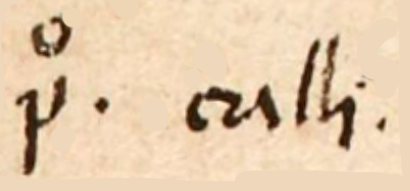
po. calli.
Pedro Calli
Stephanie Wood
1539
Jeff Haskett-Wood
agua, casas, edificios, adobes, arquitectura, fonetismo, nombres de hombres, men’s names
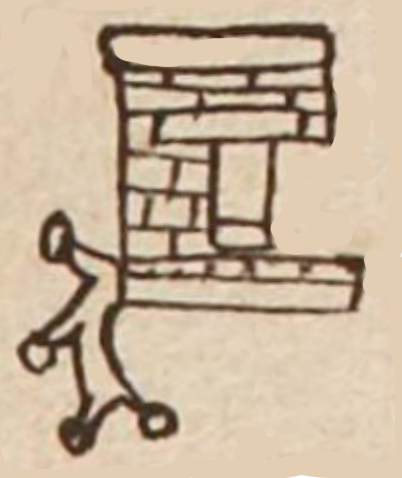
cal(li), a house or building, https://nahuatl.wired-humanities.org/content/calli
Casa (o Edificio)
Stephanie Wood
Available at Codex Vergara, folio 23r, https://gallica.bnf.fr/ark:/12148/btv1b84528032/f53.item.zoom, accessed 22 February 2026. The Vergara is associated with Tepetlaoztoc, in the larger region of Tetzcoco, c. 1539–1543.
The non-commercial reuse of images from the Bibliothèque nationale de France is free as long as the user is in compliance with the legislation in force and provides the citation: “Source gallica.bnf.fr / Bibliothèque nationale de France” or “Source gallica.bnf.fr / BnF.” We would also appreciate a citation to the Visual Lexicon of Aztec Hieroglyphs, https://aztecglyphs.wired-humanities.org/.