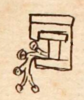
Calhua (Verg24v)
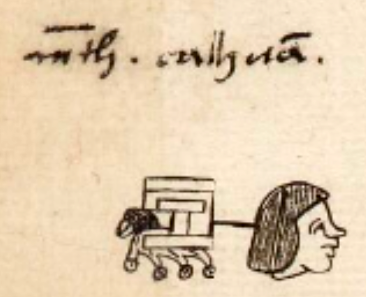
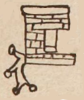
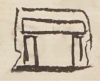
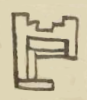
This compound Nahuatl hieroglyph is a black-line drawing of the personal name Calhua (“He Has a House”), attested here as a man’s name. The glyph has three elements. One is the house, in a profile view, facing left. Coming out of the entrance is a black bird’s head. This may stand for -hua in some way that currently escapes us. Finally, the water (atl) underscores that the name contains the vowel a-.
Stephanie Wood
The gloss includes the overbar that would suggest that this name had a plural possessor (-huan, as in “They Possess a House”), so perhaps it refers to a family–rather than an individual–with a house.
Stephanie Wood
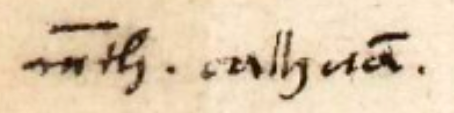
mth. calhuā.
Matheo Calhua
Stephanie Wood
1539
Jeff Haskett-Wood
casas, houses, arquitectura, pájaro, pájaros, agua, nombres de hombres, men’s names
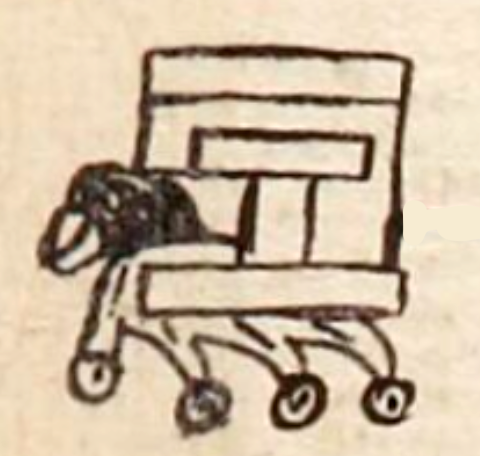
cal(li), house or building, https://nahuatl.wired-humanities.org/content/calli
-hua, one who possesses that thing, singular possessive suffix, https://nahuatl.wired-humanities.org/content/hua
posiblemente, El Poseedor de Casa
Stephanie Wood
Available at Codex Vergara, folio 24v, https://gallica.bnf.fr/ark:/12148/btv1b84528032/f56.item.zoom, accessed 22 February 2026. The Vergara is associated with Tepetlaoztoc, in the larger region of Tetzcoco, c. 1539–1543.
The non-commercial reuse of images from the Bibliothèque nationale de France is free as long as the user is in compliance with the legislation in force and provides the citation: “Source gallica.bnf.fr / Bibliothèque nationale de France” or “Source gallica.bnf.fr / BnF.” We would also appreciate a citation to the Visual Lexicon of Aztec Hieroglyphs, https://aztecglyphs.wired-humanities.org/.