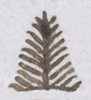
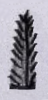
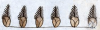
centzontli (TK204v)
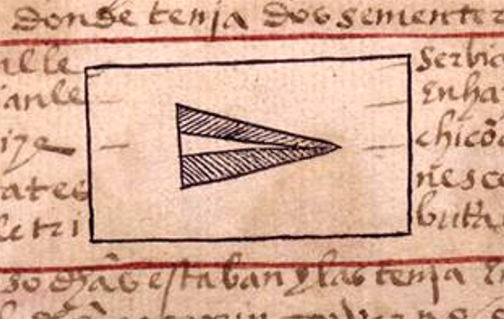
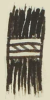
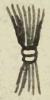
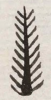
This simplex Nahuatl hieroglyph doubles as a notational sign for the number 400 (which we are labeling a centzontli, also known as a tzontli). Here, the glyph is reminiscent of a horizontal feather, but sometimes it appears as a vertical bundle of sticks, a tree, or a vertical ponytail of human hair, all objects that might contain four hundred individual items. This sign is placed in the middle of a horizontal rectangle (a “sementera” in the Spanish explanation, i.e., an agricultural field), and it represents a measurement of “quatrocientas braças” (400 fathoms).
Stephanie Wood
Whether 400 brazas is an areal measurement or the length of the rectangle is not made clear. It is assumed that the reader will understand. The term centzontli can mean “one tzontli” or “an entire tzontli.” This manuscript was produced as part of the community’s resistance through the court system to the unreasonable taxation being demanded vis-a-vis the size of the community, especially as the population was declining as a result of diseases inadvertently brought over from Europe.
Side Note: The folio numbers are not always clear in the copy published online by the British Museum. Marc Thouvenot gives this page the number K02_B in his TLACHIA digital collection, https://tlachia.iib.unam.mx/tepetlaoztoc/K02_B.
Stephanie Wood
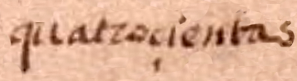
quatroçientas
cuatrocientas
Stephanie Wood
c. 1556
Jeff Haskett-Wood
medidas, agricultura, sementeras, números, cuatrocientos

centzon(tli), four hundred, https://nahuatl.wired-humanities.org/content/tzontli
cuatrocientos
Stephanie Wood
The Codex Kingsborough, also known as the Códice de Tepetlaoztoc, and the Memorial de los indios de Tepetlaoztoc, is not on display. It was transferred from the British Library and is now held by the British Museum. It is shared on line at: https://www.britishmuseum.org/collection/object/E_Am2006-Drg-13964
©The Trustees of the British Museum. Shared under a Creative Commons Attribution-Non-Commercial-ShareAlike 4.0 International (CC BY-NC-SA 4.0) license. Please also cite the <em>Visual Lexicon of Aztec Hieroglyphsem>, ed. Stephanie Wood (Eugene, Ore.: Wired Humanities Projects, 2020-present) and this URL.