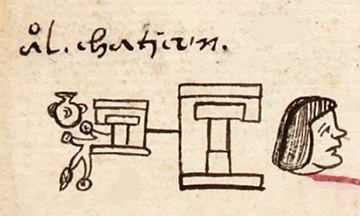
Chanticotzin (Verg26v)
This compound Nahuatl hieroglyph is a black-line drawing of the personal name Chantictzin (apparently a reference to the female divine force associated with the hearth, Chantico, “In the Home”), attested here as a man’s name. The compound has three elements, two of them seemingly phonetic indicators. First is the sign for chantli (home), which looks just like calli (house). The water (atl) seems to be a phonetic complement, clarifying that the first syllable includes the vowel sound “a.” The -co suffix to the name (without the reverential -tzin ending) would come from the pottery jug (comitl).
Stephanie Wood
If this is indeed a reference to the pre-contact sacred force of fire (female), Chantico, then perhaps the tlacuilo has gone to some lengths to disguise the name by making it phonetic as a way to avoid conflict with the colonial clergy. Serious events in Tetzcoco 1539 may have made Nahua tlacuilos more cautious when writing and painting about aspects of their faith. See Patricia Lopes Don for information about the Inquisition case against don Carlos Ometochtli, a Chichimecatecuhtli (or Chichimecateuctli) executed in late 1539, in Bonfires of Culture, 2010. Bradley Benton (The Lords of Tetzcoco, 2017, 46) also writes that the case “demonstrates that blatant disregard for Christianity had serious consequences.” The tonalpohualli, being used for "prognostication and divination, had no parallel and contravened Christian dogma so its use was disavowed and prohibited." [See Rubén G. Mendoza, Ritual Human Sacrifice in Mesoamerica (2024), 439.] Nevertheless, calendrics were an important part of Nahuas' religious views of the cosmos, and this practice survived a long time under colonialism, even if in modified form.
Stephanie Wood
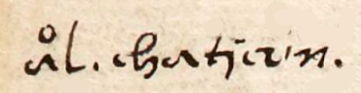
aol chaticzin
Alonso Chanticotzin
Stephanie Wood
1539
Jeff Haskett-Wood
arquitectura, casa, casas, hogar, hogares, fuego, agua, barro, cerámica, fonetismo, nombres de hombres, men’s names, nombres de fuerzas divinas, nombres de fuerzas sagradas, earthenware, ceramic, ceramics, jug, pot, olla, jarra, jarro, vessel, vessels, vasija de cerámica, cántaro, cántaros, xoctli, xoctepi, huicolli, atlacuihuani, tecomitl, tecontontli, apilolli
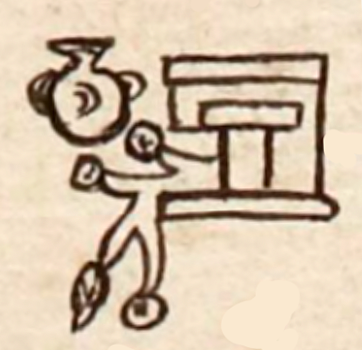
Chantico, female divine force associated with fire, https://nahuatl.wired-humanities.org/content/chantico
(el nombre de la fuerza divina del fuego, Chantico, “En el Hogar”)
Stephanie Wood
Available at Codex Vergara, folio 26v, https://gallica.bnf.fr/ark:/12148/btv1b84528032/f60.item.zoom, accessed 22 February 2026. The Vergara is associated with Tepetlaoztoc, in the larger region of Tetzcoco, c. 1539–1543.
The non-commercial reuse of images from the Bibliothèque nationale de France is free as long as the user is in compliance with the legislation in force and provides the citation: “Source gallica.bnf.fr / Bibliothèque nationale de France” or “Source gallica.bnf.fr / BnF.” We would also appreciate a citation to the Visual Lexicon of Aztec Hieroglyphs, https://aztecglyphs.wired-humanities.org/.