Chichiccuepon (MH522V)
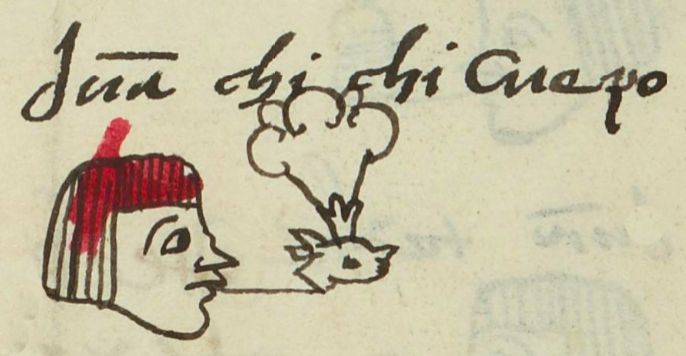
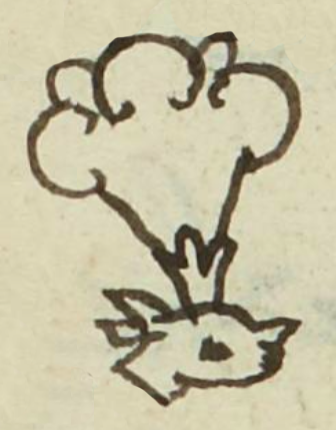
This black-line drawing of the compound Nahuatl hieroglyph for the personal name Chichiccuepon (perhaps "Bitter Bloom," attested here as a man’s name) shows a blooming or opening (cueponi) flower in a frontal view. The flower has three prominent petals and a base with three parts. Below the flower appears an animal head, probably a small dog (chichi), looking toward the viewer's right. This dog could a phonetic indicator for chichic, something bitter, in reference to the flower. If so, then the spelling of the name would be Chichiccuepon. But if this is a "Dog Flower," then we would need to adjust the spelling of the name to Chichicuepon.
Stephanie Wood
Este dibujo de trazos negros del jeroglífico compuesto náhuatl para el nombre propio Chichiccuepon (quizá “Floración Amarga”) se registra aquí como el nombre de un hombre y muestra una flor de frente que se abre o que florece (cueponi), con tres pétalos prominentes y una base de tres partes. Debajo de la flor se aprecia la cabeza de un animal que posiblemente sea un perro (chichi) pequeño que mira hacia la derecha del espectador. El can podría ser un indicador fonético de chichic (amargo) para referirse a la flor: en ese caso, la ortografía del nombre sería Chichiccuepon; pero si se tratase de una “Flor Perro”, deberíamos escribir Chichicuepon, con una sola ce.
It is unclear whether the "chichi" (dog) element in the name is literal or a phonetic indicator for a certain kind of flower, such as a bitter flower. A large percentage of flowers in the Matrícula de Huexotzinco have three predominant petals, like this one. The flowers in the Codex Mendoza are somewhat different, although one type has three petals, too. But there is no visual element here that obviously suggests "bitter."
There was a poet-lord called Chichicuepon (spelling?) who ruled in Chalco in the fifteenth century. [See: Miguel León-Portilla, Fifteen Poets of the Aztec World, 1992, 249.) And, in A Nahuatl-English Dictionary and Concordance to the Cantares Mexicanos (1985, 77), John Bierhorst mentions two men named Chichicuepon (spelling?), citing Chimalpahin. One was the ruler of the Chalcan town of Opochhuacan who died in 1332, and one was a Chalcan noble who died in 1458. A. Wimmer (2004), in the Gran Diccionario Náhuatl, mentions a Chichicuepotzin. All of these examples of the name seem to stem from the work of the annalist Chimalpahin. Perhaps he was correct, but since the extra "c" is barely heard, if at all, it could well be that he made an inadvertent omission of the final "c" of chichic.
Stephanie Wood
No está claro si el elemento chichi (perro) en el nombre es literal o si se trata de un indicador fonético para un cierto tipo de flor: recuérdese que un gran número de las flores en la Matrícula de Huexotzinco cuenta con tres pétalos predominantes, como en el presente ejemplo, mientras que las flores en el Códice Mendocino son ligeramente diferentes, aunque un tipo dado también cuenta con tres pétalos; pero en este ejemplo no apreciamos elemento visual alguno que sugiera algo “amargo” de manera patente.
Como podemos leer en Quince poetas del mundo náhuatl de don Miguel León-Portilla (1994: capítulo XVI), en el siglo XV hubo un poeta y señor de Chalco llamado Chichicuepon. Por su parte, John Bierhorst cita a Chimalpahin en A Nahuatl-English Dictionary and Concordance to the Cantares Mexicanos (1985: 77) para mencionar la existencia de dos personas llamadas Chichicuepon: uno fue el gobernante del pueblo chalca de Opochhuacan y murió en 1332, mientras que el otro fue un noble chalca fallecido en 1458. Por su parte, el Gran Diccionario Náhuatl nos informa que A. Wimmer (2004) menciona a un Chichicuepotzin. Todos los ejemplos de este nombre parecen provenir de los escritos de Chimalpahin, quien quizá no se equivocaba; pero, dado que la ce adicional es casi imperceptible, podría darse el caso de que haya omitido la ce final de chichic sin darse cuenta.
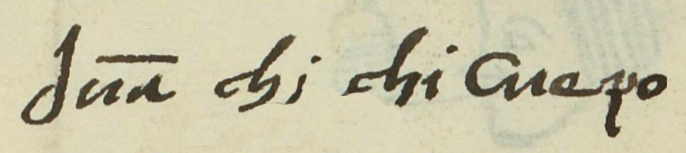
Juā chi chicuepo
Juan Chichiccuepon
Stephanie Wood
1560
José Aguayo-Barragán
dogs, perros, flowers, flores, abrir, brotar, open, bloom, blossom, fonetismo, nombres de hombres, men's names
cueponi, to blossom, bloom, open, https://nahuatl.wired-humanities.org/content/cueponi
chichi, a dog, https://nahuatl.wired-humanities.org/content/chichi
chichic, something bitter, https://nahuatl.wired-humanities.org/content/chichic
Perro-Flor Abriendo
Stephanie Wood
Matrícula de Huexotzinco, folio 522v, World Digital Library. https://www.loc.gov/resource/gdcwdl.wdl_15282/?sp=184&st=image
This manuscript is hosted by the Library of Congress and the World Digital Library; used here with the Creative Commons, “Attribution-NonCommercial-ShareAlike 3.0 License” (CC-BY-NC-SAq 3.0).