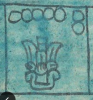
Chicomaca (MH648v)
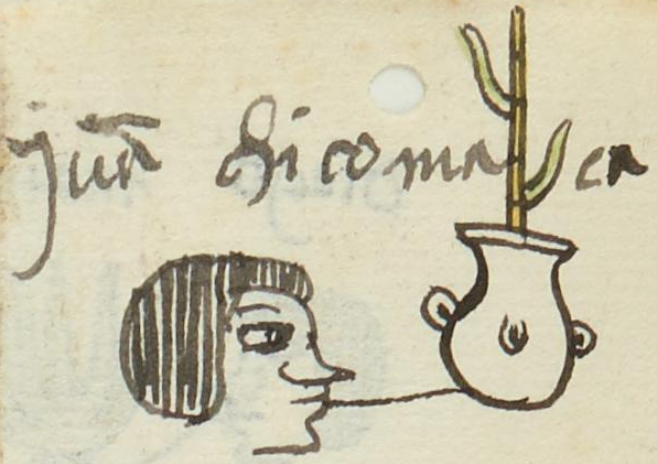
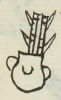
This colorful painting of the compound Nahuatl hieroglyph glyph for the personal name Chicomacatl (or "Chicome Acatl," "Seven Reed," or 7-Reed) is attested here as a man's name. The compound includes a pot (comitl), a phonetic disyllabogram for the "chicom," drawing from the comitl (jug or pot). The reed (acatl) is vertical, yellow, and segmented. It has two green leaves. It is a logogram.
Stephanie Wood
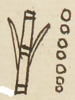
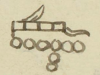
This is a calendrical name from the 260-day religious, divinatory calendar, the tonalpohualli. If not specifically referring to the calendar, the name can also refer to a medicinal herb called chicomacatl, which probably still also has associations with the calendar. Originally, a calendrical name such as this would have shown the number seven in a notation of dots. Perhaps to disguise the fact that this was a calendrical name, the pot takes the place of the notation. Serious events in 1539 may have made Nahua tlacuilos more cautious when writing and painting about aspects of their faith. See Patricia Lopes Don for information about the Inquisition case against don Carlos Ometochtli, a Chichimecatecuhtli (or Chichimecateuctli) executed in late 1539, in Bonfires of Culture, 2010. Bradley Benton (The Lords of Tetzcoco, 2017, 46) also writes that the case “demonstrates that blatant disregard for Christianity had serious consequences.”
The tonalpohualli, being used for "prognostication and divination, had no parallel and contravened Christian dogma so its use was disavowed and prohibited." [See Rubén G. Mendoza, Ritual Human Sacrifice in Mesoamerica (2024), 439.] Nevertheless, calendrics were an important part of Nahuas' religious views of the cosmos, and this practice survived a long time under colonialism, even if in modified form.
Stephanie Wood
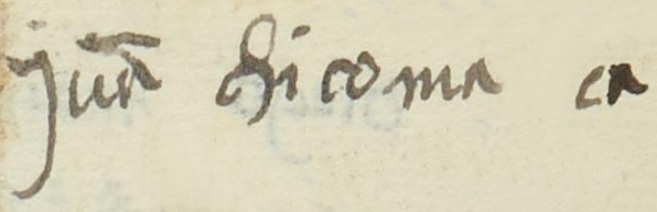
juā chicomaca
Juan Chicomaca
1560
Jeff Haskett-Wood
cerámica, plantas, cañas, días, fechas, calendarios, tonalpohualli, nombres de hombres, men’s names, fonetismo, earthenware, ceramic, ceramics, jug, pot, olla, jarra, jarro, vessel, vessels, vasija de cerámica, cántaro, cántaros, xoctli, xoctepi, huicolli, atlacuihuani, tecomitl, tecontontli, apilolli
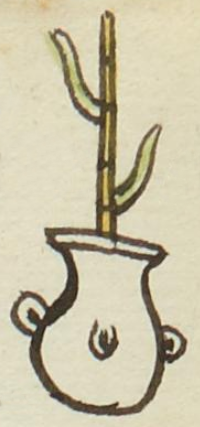
chicome, seven, https://nahuatl.wired-humanities.org/content/chicome
aca(tl), reed or cane, https://nahuatl.wired-humanities.org/content/acatl
Siete Caña, o 7-Caña
Stephanie Wood
Matrícula de Huexotzinco, folio 648v, World Digital Library, https://www.loc.gov/resource/gdcwdl.wdl_15282/?sp=379&st=image
This manuscript is hosted by the Library of Congress and the World Digital Library; used here with the Creative Commons, “Attribution-NonCommercial-ShareAlike 3.0 License” (CC-BY-NC-SAq 3.0).