Chicontetl (MH649r)
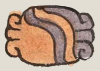
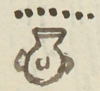
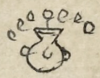
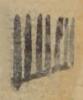
This black-line drawing of the compound and notation glyph for the personal name Chicontetl ("Seven") is attested here as a man's name. The seven dots at the top represent the number seven (chicome, which can also be expressed as chicontetl). The pottery jug (comitl) provides the phonetic syllable -co in the middle of the name. The stone, which is only half visible, provides the phonetic syllable -tetl. The stone has the typical horizontal position, the curly ends, and the diagonal stripe across the middle.
Stephanie Wood
The suffix -tetl is an old-fashioned numerical classifier that was used for counting things that were round and solid, but it apparently gradually lost that significance and just became another way of saying a number, of saying that something is countable.
This name may have been a calendrical name from the tonalpohualli, 260-day religious divinatory calendar, which would involving having a day name (one of twenty different possibilities) plus a number from 1 to 13. The colonial clergy made an effort to prohibit the use of this calendar for naming children, which may have led to the suppression of day names or, if the day name was kept, just using the number. How people responded to this effort is unclear. Might they have disguised some of these names by dropping part of the name, or might it just be a natural apocopation, or perhaps a gradual loss of memory about how the calendar functioned?
The tonalpohualli, being used for "prognostication and divination, had no parallel and contravened Christian dogma so its use was disavowed and prohibited." [See Rubén G. Mendoza, Ritual Human Sacrifice in Mesoamerica (2024), 439.] Nevertheless, calendrics were an important part of Nahuas' religious views of the cosmos, and this practice survived a long time under colonialism, even if in modified form.
Stephanie Wood
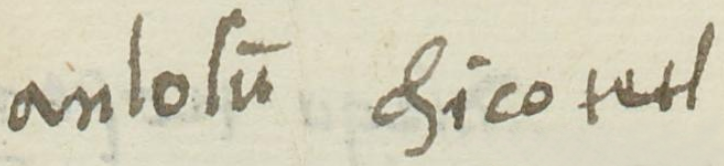
anlosū chicotetl
Alonso Chicontetl
Stephanie Wood & Jeff Haskett-Wood
1560
Jeff Haskett-Wood
números, siete, cerámica, piedras, nombres de hombres, tonalpohualli, men’s names, earthenware, ceramic, ceramics, cerámicas, jug, pot, olla, jarra, jarro, vessel, vessels, vasija de cerámica, cántaro, cántaros, xoctli, xoctepi, huicolli, atlacuihuani, tecomitl, tecontontli, apilolli
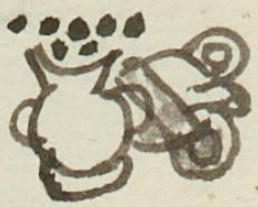
chicome, seven, https://nahuatl.wired-humanities.org/content/chicome
chiconte(tl), seven, https://nahuatl.wired-humanities.org/content/chicontetl
com(itl), ceramic pot, https://nahuatl.wired-humanities.org/content/comitl
te(tl), stone,https://nahuatl.wired-humanities.org/content/tetl
Siete
Stephanie Wood
Matrícula de Huexotzinco, folio 649r, World Digital Library, https://www.loc.gov/resource/gdcwdl.wdl_15282/?sp=379&st=image
This manuscript is hosted by the Library of Congress and the World Digital Library; used here with the Creative Commons, “Attribution-NonCommercial-ShareAlike 3.0 License” (CC-BY-NC-SAq 3.0).