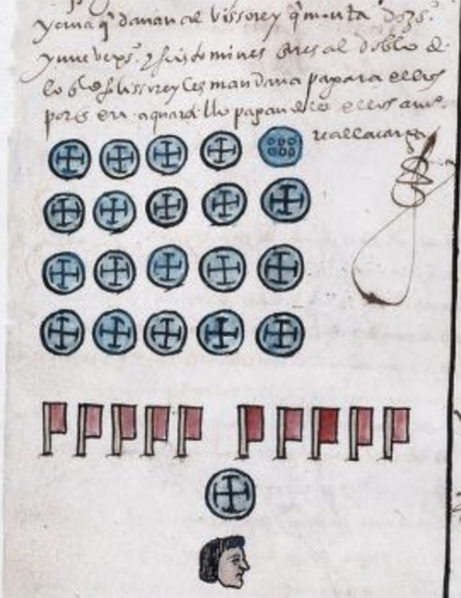
chicuacen tomin (Osu14v)
This painted simplex Nahuatl hieroglyph stands for six tomines (a loanword from Spanish, each unit being an eighth of a peso, which was also called a real) part of a large payment of over 200 pesos that the viceroy ordered the Nahuas be paid for their work in gathering and presenting loads of fodder for the horses of the magistrates of the high court in Mexico City. The judges had regularly demanded loads of grasses and had not paid for them. The viceroy was trying to rectify the situation after the Nahuas had drawn up strenuous objections about the abuses of the magistrates in hieroglyphic and alphabetic Nahuatl. This example lacks a Nahuatl gloss that identifies it, but there is a reference to it in the Spanish text, and there are other tomines with glosses or textual references that support this interpretation.
Stephanie Wood
The six tomines represented here in a single coin are somewhat unusual. Often, we will see four tomines (a blue coin either with four tiny circles in the middle or the digit 4) plus two tomines (another blue coin with two tiny circles, looking much like a western button of today). See the example of chicome tomin (seven tomines), below. Or, another option would be to show two coins where each one has three small circles, for a total of six tomines.
Stephanie Wood
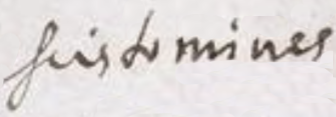
seis tomines
Stephanie Wood
1551–1565
Jeff Haskett-Wood
dinero, moneda, monedas

chicuacen, six, https://nahuatl.wired-humanities.org/content/chicuacen
tomin, a coin worth ⅛ of a Spanish peso or one real, https://nahuatl.wired-humanities.org/content/tomin
seis tomines, o seis reales
Stephanie Wood
Library of Congress Online Catalog and the World Digital Library, Osuna Codex, or Painting of the Governor, Mayors, and Rulers of Mexico, https://www.loc.gov/resource/gdcwdl.wdl_07324/. The original is located in the Biblioteca Nacional de España.
"The Library of Congress is unaware of any copyright or other restrictions in the World Digital Library Collection. Absent any such restrictions, these materials are free to use and reuse." But please cite the Biblioteca Nacional de España and this Visual Lexicon of Aztec Hieroglyphs if you use any of these images here or refer to the content on this page, providing the URL.