Chicuicnaozoma (Verg22r)
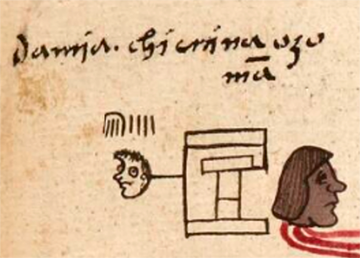
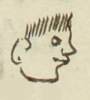
This black-line drawing of the simplex glyph for the personal name Chicuicnaozoma (“Nine Monkey” or “9-Monkey”) is attested here as a man’s name. The monkey’s head is shown in profile, facing the viewer’s left. He has the characteristically large, round eyes. He has a beard, and his hair stands up and curls forward. This is a calendrical name, taken from the 260-day divinatory calendar called the tonalpohualli. The number nine is shown as a group of five ones in the form of vertical line (which has an arching line that groups them) and four additional ones. The gloss provides the unusual spelling for nine (chicuicna-), but the clarity of the notation would support the alternate spelling Chiucnauhozoma. Another example, with an even clearer gloss appears on folio 23 verso. This spelling (“chichuic-”) seems to be a variant. Another Chicuinaozoma appears with the same first name on folio 25 verso.
Stephanie Wood
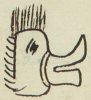
The glyph for monkey very typically shows the hair (tzontli) on the top of its head standing up, and sometimes the hair is long and thick, and so very noticeable. Perhaps this portrayal of hair is meant to serve as a phonetic complement for the "-zom-" in the middle of the root ozoma, given that "tzon-" stands for hair. The ozomatli is a day sign in the calendar, so it was given as a name to babies born on its day. There was also a divine force or deity named Ozomatli, which, according to Desmond Morris (Monkey, 2013, 41), was "the companion spirit and servant of the god Xochipilli, the deity of music and dance. In paintings it is depicted dressed in malinalli herbs and with white, oval earrings with pointed ends."
Stephanie Wood
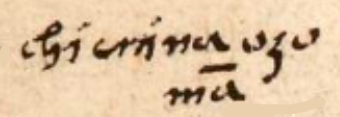
damia.chicuicnaozomā
Damian Chicuinaozoma or Chiucnauhozoma
Stephanie Wood
1539
Jeff Haskett-Wood
monos, primate, primates, animals, animales

ozoma, a monkey, https://nahuatl.wired-humanities.org/content/ozoma
Nueve Mono, o 9 Mono
Stephanie Wood
Available at Codex Vergara, folio 22r, https://gallica.bnf.fr/ark:/12148/btv1b84528032/f51.item.zoom, accessed 21 February 2026. The Vergara is associated with Tepetlaoztoc, in the larger region of Tetzcoco, c. 1539–1543.
The non-commercial reuse of images from the Bibliothèque nationale de France is free as long as the user is in compliance with the legislation in force and provides the citation: “Source gallica.bnf.fr / Bibliothèque nationale de France” or “Source gallica.bnf.fr / BnF.” We would also appreciate a citation to the Visual Lexicon of Aztec Hieroglyphs, https://aztecglyphs.wired-humanities.org/.